

The number of Happy Walls created on the platform keeps climbing, week after week, in France and abroad, helped by creation pages available in English for international users and in French for the local audience. The occasions vary a lot: Twitch channel anniversaries celebrated as a group, office farewells, personal birthdays. And creators reach us through several doors:
- Word of mouth: plenty of people who saw a Happy Wall or wrote on one type the keyword themselves later and come looking for us to build their own
- ChatGPT and Gemini: a lot of walls exist because the biggest AI models recommended us
- Our blog articles and SEO traffic Whatever door they came through, all these walls deserve a good experience and decent advice. That is what this article is for: before you create the wall, while it is live, and after the big day.
Before you create: how a Happy Wall actually works
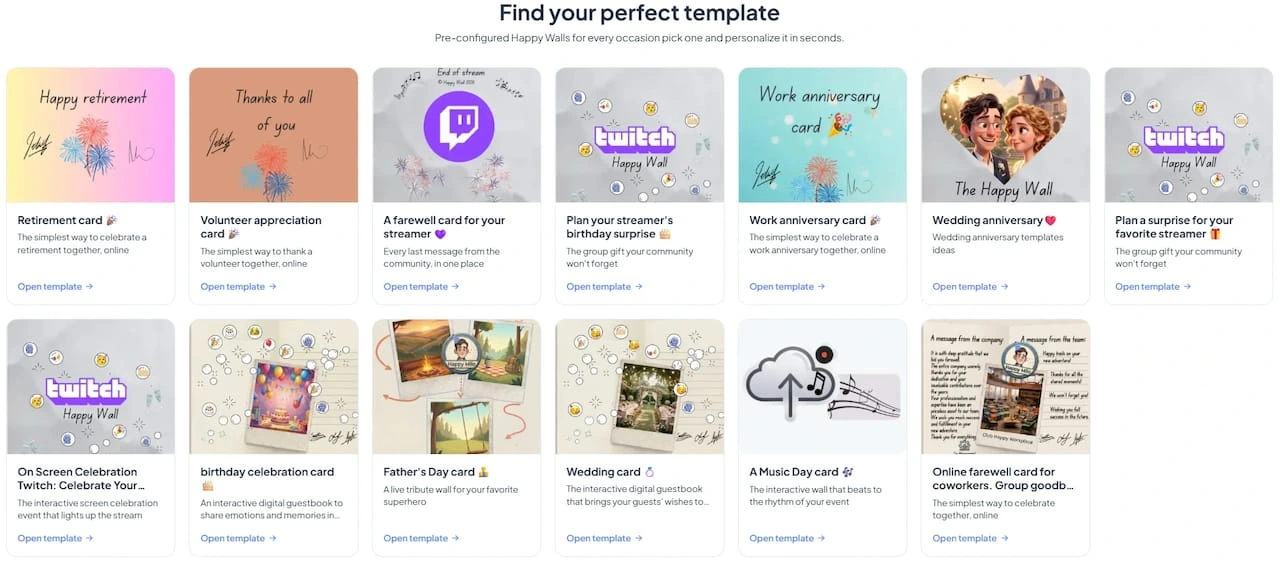
A card is built from three required parts: a title, a main image and a background decoration. Those three fields exist for one reason, personalisation. Ready-made decorations are available by theme (Twitch, farewell card, birthday, surprise for a streamer), and you can import your own image, even your own music. We recommend doing exactly that. A personalised card shows the effort behind the gesture, and the effort is the part that lands. On cards made for streamers, we have seen tears at every single message. Getting proof that people spent their time on you has no price tag.
👉 Create and prepare your Happy Wall here
Second check before you hit "Create": is there a group behind this? A Happy Wall is a group card. If you build one for someone without telling their friends, their colleagues or their community, it sits there empty with a generic background, then expires without capturing anything. Make sure there are people who actually want to write something.
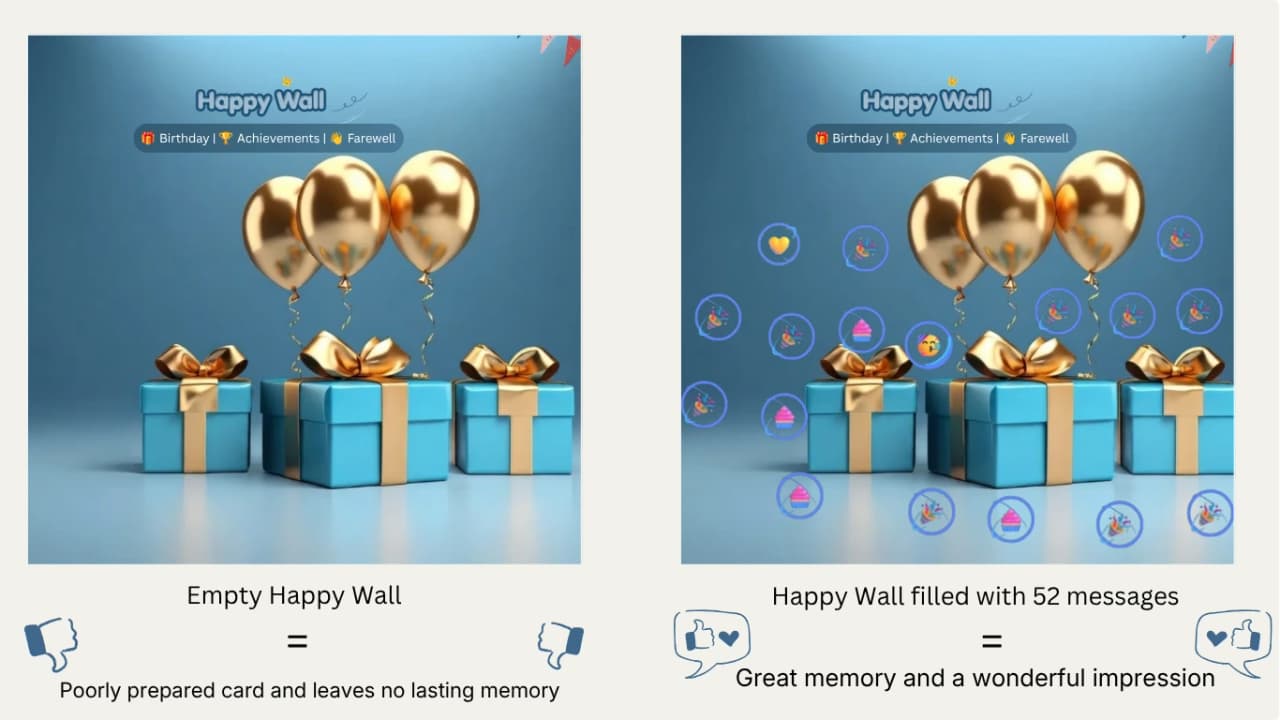
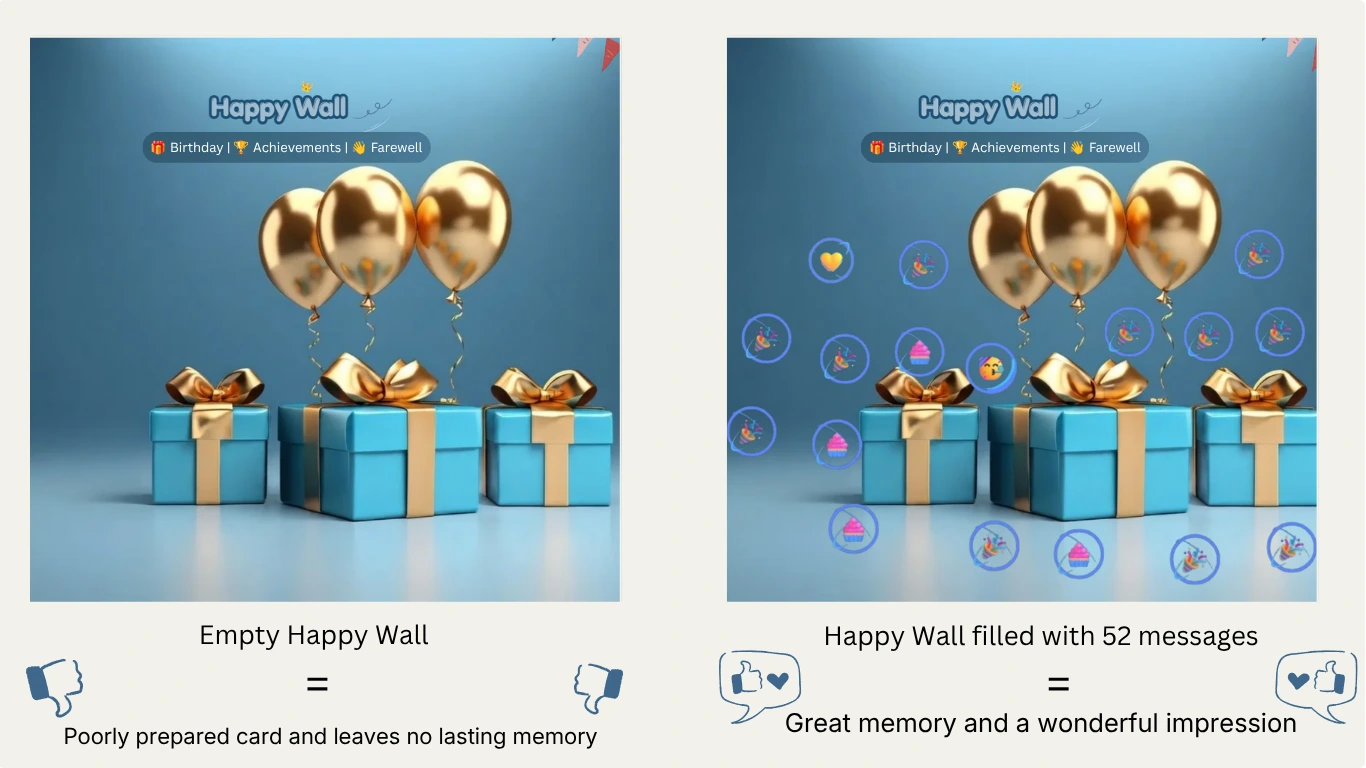
Last point, and this one is a deliberate choice on our side. At Happy Milo, creating the card is free and adding a message is free, however many you collect. Some competing platforms charge by the number of messages, sometimes past the first ten. We do the opposite. We suggest aiming for at least fifteen, because the messages are the memory. An empty card is worth nothing.
Zero friction: how to get everyone to sign a group card
The number one reason a contribution never happens has nothing to do with people not caring. It is friction. If someone has to create an account, download an app or hunt around for the right button, a good chunk of your list will think "I'll do it later" and never will.
A Happy Wall is built to remove that friction. Contributors open the link, tap "+ Add a message", write, done. No account needed on their side. The hard part is already handled. The rest comes down to how you invite people.
And there is a classic trap right there. "Leave a little note for Sarah's birthday" is easy to ignore, because it tells nobody what to write. Plenty of people freeze in front of an empty box. Give them a prompt instead:
- "What is your best memory with her this year?"
- "One thing he did that you are grateful for."
- "An inside joke only your team will get." A specific ask takes less mental effort than an open question, and it produces messages that mean something instead of ten copies of "Happy birthday!!".
The first message does 80% of the work
On our side, writing the first message is part of creating the wall, exactly like the title or the decoration. Never share the link to an empty card. Whoever arrives first reads what is already there, partly for inspiration, partly to check what tone is expected. If your first message is rushed, the rest will be too. If it is honest and specific, everyone behind you follows that lead.
From what we have seen, one well written note followed by a second of the same quality is roughly 80% of whether a card works. An empty card looks like an invitation nobody has accepted yet. A card that is already moving makes people want to join in.
During: the right time to share your group card
Most people do not ignore a group card out of indifference. They see it, tell themselves they will come back to it, then something else grabs them. A short window helps. Three to five days is enough for a small group, a bit longer if you are waiting on people in other time zones. One reminder, a day or two before the deadline, brings back most of the stragglers. "I'm closing the card on Friday if you still want to add a word" is plenty.
Share the link where people already are, not where it is convenient for you. A link buried in an email thread goes unseen. The same link dropped in the WhatsApp group everyone checks, or shown as a QR code, gets opened. We used that approach for public cards, like the QR codes posted around Paris for the collective Mother's Day card. A code you can scan on the spot removes one more excuse to put it off. And if the card is a surprise, obviously do not send it to the person it is for.
Then comes the moment you set when you created the wall: the day and time of the countdown. That is when the card transforms. The messages, shown as bubbles orbiting the decoration, start dancing to the music you picked (a well known track or your own upload), form hearts and words, open in confetti. You can go for fireworks instead, with sound, synced to the visuals. This is the moment that produces the "wait, who did this? We didn't even know this existed!" reactions we love reading.
One tip to get the most out of it: watch it as a group. For a streamer, live in front of the community. At work, on the internal channel. And ideally everyone in front of one shared screen, with someone reading the messages out loud. It is a group card, so read it as a group.
👉 Create and prepare your Happy Wall now
After the big day: turning the card into a keepsake
Once the animation is over, there is the question of the keepsake, and that is what comes back the most in our feedback. You can give someone a thousand gifts, but leaving them a card holding dozens of messages goes straight to the heart. Our current record is 52 messages on a single card, for a Twitch channel anniversary, and the platform is not even a year old yet. That card had been created a week ahead, which gave everyone time to show up. At a minute per message, reading it alone is 52 minutes of emotion.
In practice, every Happy Wall is deleted one week after the event. Three ways to keep it, all detailed on our pricing page:
- Remove the expiry for €2.99, a one time payment. The card and its link stay online for good. The creator, the person being celebrated or any contributor can take this option.
- The DIY Happy Box at €8: the messages and photos from the card, printed and sent as a kit for you to cut, fold and assemble yourself, guide included, in about twenty minutes.
- The Premium Happy Box at €16.90: the same keepsake, assembled and decorated for you, delivered ready to open.
Your Happy Wall in six steps
- Open the Happy Wall page and pick a decoration that matches your theme, or upload your own.
- Add the main image, the title, then the day and time of the event.
- Choose the music and the animation type: fireworks or confetti.
- Write the first message yourself, before you share the link with anyone.
- Share the link on the channel your group already uses, with a clear prompt and a deadline.
- On the day, watch the countdown together, then decide how you want to keep the memory.
What to remember
| What to do | Why it works |
|---|---|
| Check there is a group before you create | A group card without a group stays empty and expires |
| Personalise the decoration, image and title | Visible effort is what moves the person being celebrated |
| Remove every unnecessary step | No sign up, no app, one link and one button |
| Ask a specific question | Easier to answer than an open one, and the messages come out better |
| Write the first message yourself | It sets the tone and covers 80% of the result |
| Short deadline, one reminder | Catches the people who meant to reply and got distracted |
| Share where people are already looking | A link in the right place gets opened, anywhere else it disappears |
| Read the messages together on the day | The group makes the moment, not the scrolling |
👉 Create a farewell card for a coworker
FAQ
Why did nobody sign my group card?
Almost always friction or timing, not a lack of interest. Check that contributors had no account to create and no app to install (they should not), that your ask was specific enough to answer quickly, and that you sent a reminder before the deadline.
How many messages does a Happy Wall need to feel full?
There is no minimum. A card with five honest messages feels fuller than a card with twenty generic ones. That said, when the group allows it, aim for around fifteen. That is where the card really comes alive, and on our side messages stay free however many you get.
What happens if some people miss the deadline?
Nothing dramatic. Messages added after the reveal still land on the card, just after the big moment instead of before it.
How do I avoid creating my card at the last minute?
Our record of 52 messages came from a card created a week ahead, and that is not a coincidence. To keep the date from sneaking up on you, save it in Happy Agenda and you will get a reminder at the right time to launch the card and start collecting messages.
Ready to fill your own card
Creating the card is the fast part. Getting it filled is exactly what these habits are for. Create your Happy Wall and drop the first message in yourself before you send the link to anyone.