
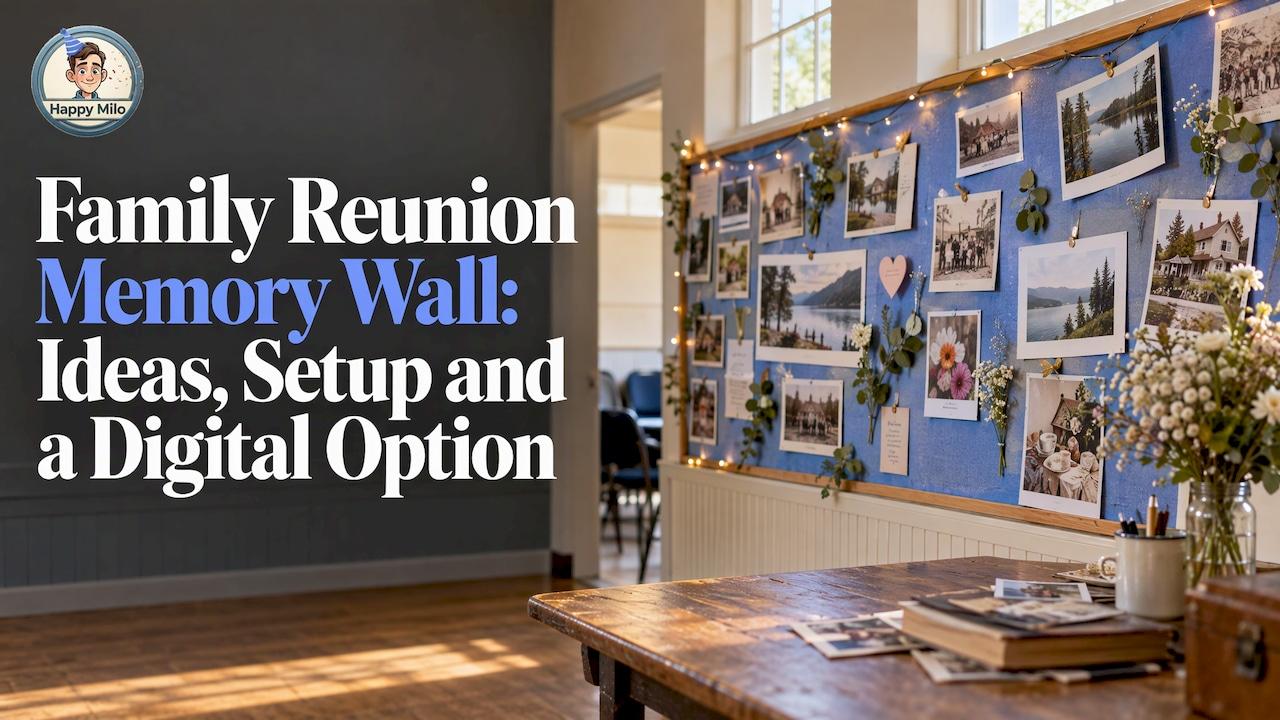

A family reunion memory wall is one place where everyone’s photos, stories and messages come together, so the day does not disappear the moment the cars pull out. You can build it on a chalkboard or foam board at the venue, or online with a shared link that cousins can open from anywhere. The best walls do both: a physical spot people can gather around, and a digital one that also reaches the relatives who could not travel. This guide shows you how to set one up, what to ask for, how to honor family members who have passed, and how to keep everything afterward. 🎉
What a memory wall is, and how it differs from a guest book
A guest book is a record of who came. Guests sign their name and, if they like, add an address or phone number, then leave a comment about a favorite moment as the day winds down. One reunion guide describes exactly that pattern: identification first, recollection second.
A memory wall is a record of what the family means to each other. It is built from photos, short stories, jokes, wishes and questions, and it grows throughout the event instead of being filled in at the door. Think of the guest book as the attendance sheet and the memory wall as the family scrapbook that everyone writes in at once.
The two work well together:
- The guest book answers “who was here?”
- The memory wall answers “what do we remember, and what do we want to say to each other?”
- A digital wall can do both jobs, because each person who adds a message is automatically signing it.
If you only have time for one, choose the wall. Names tell you who showed up, but stories are what people reread years later.
1. Choose your format: physical, digital or both
There is no single right answer. It depends on the size of your family, how spread out it is, and how comfortable everyone is with a phone.
A physical wall at the venue
A physical wall gives people something to gather around, and it is easy for kids to join in. Planning guides for reunions regularly suggest photo swaps, storytelling, group photos and displays of family heirlooms as core activities, and a wall gives all of them a home. Another long-standing planning guide suggests displaying old photos and memorabilia and using the day to build a photo album, story book, video or recipe book.
Simple materials that work:
- A large chalkboard panel, corkboard or foam board, with a prompt written clearly at the top
- Clothespins and string for hanging photos
- Pens, markers and index cards in a few colors
- Sticky notes for short wishes and memories
- A small table nearby with a basket of blank cards and a few chairs
One practical tip: photograph the wall before everyone leaves. A chalkboard can be wiped, a board can get bent in a trunk, and a picture of the finished wall is the easiest way to save it.
A digital wall anyone can join
A digital wall solves the problems a physical one cannot. Aunts in Arizona, cousins overseas and grandchildren who are in college can all add something, before, during or after the weekend. You do not need to ask anyone to print photos or mail anything.
With a Happy Wall, you create one shared card and send the link to the family. Anyone with the link can add a message, photo or wish, and there is no limit on how many people can join in. When you open the wall at the reunion, it comes alive with music, confetti and animation, which is a lovely moment to project onto a screen or pass around on a tablet.
Both together
Most families end up happiest with a hybrid:
- Open a digital wall two to three weeks before the reunion so relatives can add photos and short intros ahead of time.
- Set up a physical wall at the venue for hands-on moments like caption cards, doodles and handwritten notes.
- Add photos of the physical wall to the digital one afterward, so the whole thing lives in one place.
2. Prompts that get real stories, not just “great to see you!”
A blank space is intimidating. A good prompt gives someone permission to write something small but true. Put one big prompt at the top and a few smaller ones nearby.
Memory prompts
- “What I will always remember is…” (a simple prompt like this is a popular choice on chalkboard memory walls, where guests add responses throughout the event)
- “My earliest memory of a family gathering is…”
- “The recipe or dish that tastes like home to me is…”
- “The funniest thing that ever happened at one of our reunions was…”
Connection prompts
- “Something I learned from my grandparents is…”
- “A family trait I see in myself is…”
- “A message for the youngest person in our family…”
- “A wish for our next reunion…”
Photo prompts
- “Bring one photo that shows where you were ten years ago.”
- “Post a photo of an unidentified relative and let the family name them.”
- “Add a photo of an heirloom and tell us where it came from.”
If you want guests to speak rather than write, take a look at these audio guest book prompts. The same question ideas translate nicely to a reunion, especially for relatives who would rather tell a story out loud than put it on paper.
The “mystery photo” corner
This is the part of a reunion wall people tend to love most. Gather old, unlabeled photos from albums and shoeboxes, put them out with pens and caption cards, and ask relatives to identify the people, dates and places. The family-history details that older relatives carry in their heads are exactly what disappears first, so this is worth setting up even if everything else is simple.

3. Honoring relatives who have passed
A reunion is often the one time the whole family is together, which makes it a natural moment to remember people who are no longer at the table. Done with care, it adds warmth to the day instead of weighing it down.
A funeral-care guide on honoring loved ones at reunions suggests a remembrance corner with framed photos, candles, flowers, keepsakes or written tributes, plus a moment such as a toast, candle lighting, silence or prayer, depending on what your family believes and prefers.
Here is how to fold that into a memory wall:
- Give it its own section. A separate panel or corner titled “Remembering Us” or “Always With Us” keeps it respectful and easy to find.
- Invite stories, not just names. A prompt like “A story that makes me smile about Grandpa Joe” turns a name into a person.
- Let people choose. Some relatives will want to write; others will want to stand quietly. Keep the corner open and unhurried.
- Check with close family first. If a loss is recent, ask the immediate family how they would like it handled before you plan anything public.
- Mix it with joy. Remembering and celebrating can live side by side. A short toast followed by the family’s favorite song often lands better than a long formal moment.
On a digital wall, you can add a dedicated message or post at the top with a photo and a short note, then invite relatives to add their own memories beneath it.
4. Making the wall welcome for every generation
A reunion can include a four-year-old and a ninety-four-year-old in the same room. A good wall has more than one way in.
For young kids
- Offer crayons, stickers and a “draw your favorite family moment” card.
- Let them tape or pin their own drawings, so the wall feels like theirs too.
For teens and young adults
- Digital contributions are natural to them. A link they can open on a phone and add a photo or short note to takes seconds.
- Give them a job, such as photographer or wall captain. It turns a possible eye-roll into ownership.
For older relatives
- Not everyone wants to type. Assign a volunteer to sit with grandparents and write down their memories as they tell them. Reunion guides suggest exactly this, assigning someone to transcribe for older guests or anyone who would rather dictate than write.
- Use large print and readable pens, and seat the wall in a spot with good light and chairs.
- Consider printing the prompts in large type on a sign.
For relatives far away
- Send the digital link in the family group chat or by email, with a note that no one needs to attend to contribute.
- Ask them for a short photo and a sentence or two, which is easy to do in five minutes.
The goal is simple: nobody should look at the wall and think it is for someone else.
5. A simple timeline: before, during and after
A wall that is planned in three stages feels effortless on the day. We cover this rhythm in more detail in our guide on how to make your Happy Wall work before, during and after, and it translates nicely to reunions.
Four to six weeks before
- Pick the format and create the wall.
- Send a short invitation with the link and one easy prompt.
- Ask each household or family branch for a current photo, the names of everyone in it, where they live and a short update. A memory-book guide for reunions recommends collecting one profile per household about four to six weeks ahead, which gives you time to chase stragglers gently.
The week before
- Send a reminder with a second prompt, like “Share your favorite photo from a past reunion.”
- Gather the physical supplies and decide where the wall will go.
- Recruit two or three helpers: a photographer, a scribe for older relatives and a caption-card host.
If you want a countdown that the whole family can see, Happy Dates is made for counting down to the day together. And if you are planning more than one celebration in the year, Happy Agenda helps you plan ahead so nobody forgets to open a wall in time.
During the reunion
- Put the wall where people naturally pass: near the food, the entrance or the seating area.
- Make a quick announcement at the start and again after the meal.
- Open the digital wall on a screen for a few minutes, so everyone can see the messages and photos roll in.
- Take a photo of the physical wall before it comes down.
After the reunion
- Keep the wall open for a few days so late contributors can add photos and thank-you notes.
- Share the final result with everyone, not only the organizers.
- Decide how you want to keep it (see below).
Turn the wall into something the whole family keeps
If you want a digital wall that lasts, we built Happy Wall around exactly this: gather everyone’s words in one place, then keep them. Creating a wall is free, and each wall stays open for as long as its creator sets. Once it closes, you can keep it as a digital keepsake. For a permanent version, no expiration on your Happy Wall is a one-time 2,99 €.

If you would like something to hold, the same wall can become a printed card mailed to the person it was made for through Happy Box. There are two options: Happy Box DIY, a print-at-home kit at 8,00 €, and Happy Box Premium, an assembled printed card at 16,90 €. Both are one-time prices. A printed version makes a lovely gift for a grandparent or the family’s host. You can see everything side by side on our pricing page, or start your family’s Happy Wall right now.
What a family reunion guest book should include
If you still want a classic guest book alongside the wall, keep it simple. A short list of fields works better than a long form:
- Name (and, for big families, which branch or household they belong to)
- Optional contact details, such as an address or phone number, if the family wants to build a directory. The reunion guest book advice from one long-running reunion site lists name, address and phone number as the usual entries.
- A favorite moment, written near the end of the day, once there is something to remember
- A line for the future, like “See you at the next reunion, and I will bring…”
Be clear about privacy. Addresses and phone numbers should only be collected if everyone knows how they will be used and who will see them. If you are not building a directory, leave them out.
A few extras that add real value:
- A family tree sketch on the first page, so guests can see where they fit
- Group photo pages, so each branch signs near their own photo
- Doodle space for kids
- A “heritage” page with a short family history, such as where the family came from and the story of how the reunions began
On a digital wall, each message already carries the writer’s name, which means the wall doubles as your guest book. Nobody has to pass a clipboard.
Saving the photos and stories for the long run
The worst outcome is a wonderful wall that ends up in a phone’s camera roll and is never seen again. A little organization on the day saves hours later.
- Caption everything. Names, dates and places are the first things to be forgotten. Use caption cards on physical photos and write the same details when you scan them, so they stay searchable. A reunion-planning resource recommends scanning each photo with its caption card or entering the caption into photo-management software.
- Photograph the physical wall in good light, from straight on, before it comes down.
- Collect everything in one shared folder or on the digital wall, and send the link to the whole family.
- Back it up twice, in two different places, such as a cloud folder and an external drive held by a different relative.
- Turn it into something tangible. A printed card, an album, a short video or a recipe book are all ways families have turned reunion contributions into keepsakes.
If you are also hiring a photographer for the group portrait, ask them to take a few shots of the wall and the mystery photo corner too. Those pictures become part of the story.
Extra ideas if you want to go further
A few small touches that make a wall feel special without much work:
- Theme it around your heritage. Food, music and decorations tied to your family’s background make the space instantly feel like yours.
- Add a “then and now” strip. Pair an old photo of someone with a current one.
- Run a caption contest for the funniest old photo.
- Create a recipe corner where relatives add a favorite family dish and who it came from.
- Plan the next reunion on the wall. A final prompt like “Where should we meet next?” doubles as a vote and a teaser.
If your family also likes to mark birthdays and anniversaries between reunions, our guides on online anniversary cards and group birthday tributes show how the same idea works year-round.
FAQ
How is a family reunion memory wall different from a guest book?
A guest book records who attended, usually with a name and a short comment. A memory wall collects photos, stories, jokes and wishes from the whole family, and it grows through the day. Many families use both, or use a digital wall that handles both jobs at once.
How many people can add to a digital wall?
With Happy Wall, there is no limit on how many people can join in. Anyone with the link can add a message, photo or wish, so the whole family can contribute, whether they attend in person or not.
How long should the wall stay open?
It is up to you. Each Happy Wall stays open for as long as its creator sets. Many families open it a few weeks before the reunion and keep it open a few days after, so late photos and thank-you notes can be added.
Can we keep the wall after the reunion?
Yes. Once the wall closes, you can keep it as a digital keepsake, and a one-time 2,99 € option gives you no expiration on your Happy Wall. You can also turn it into a printed card through Happy Box, starting at 8,00 € for the DIY version.
What if some relatives are not comfortable with technology?
Pair the digital wall with a physical one, and assign a volunteer to write down memories for older guests who prefer to speak rather than type. Add their contributions to the digital wall afterward, so everyone’s words end up in the same place.
Recommended
Related Articles
Done for you
Want us to help prepare it?
We'll help you create the Happy Wall for your event. Tell us the date and the occasion, we take it from there.