


Make Cards They Keep: 3 Retirement Card Templates to Personalize and Share
The best retirement card messages combine three things: genuine congratulations, one specific detail about the person’s contribution, and a warm wish for what comes next. Match your tone, to the relationship, not the occasion, so a supervisor gets professional warmth while a close friend gets personal memories and inside jokes. If you’re stuck on length, one honest sentence naming their name and what they meant to the team beats a paragraph of generic phrases.
Table of Contents
- Quick One-Liners for Cards, Texts, and Slack
- Retirement Messages for Coworkers, With Notes on What to Swap
- Writing to a Boss or Mentor: Respectful but Warm
- Heartfelt Messages for Friends and Family
- Funny Retirement Messages Without the Risk
- Long, Heartfelt Messages for Keepsake Cards
- How to Personalize Any Retirement Message
- Three Fill-in-the-Blank Templates
- Tips for Different Industries and Professions
- Common Phrases to Avoid in Retirement Messages
- Milestone Retirements: Early Retirement and Long Service
- Why a Thoughtful Card Still Matters
- Create a Group Retirement Card That Actually Gets Kept
- Sources
- FAQ
Quick One-Liners for Cards, Texts, and Slack
Sometimes you need a line, not a letter. A quick message that lands well still needs specificity, even in five words.
Formal one-liners work for client-facing cards or when you don’t know the person well:
- “Wishing you a retirement filled with peace, purpose, and everything you’ve earned.”
- “Congratulations on this incredible milestone. Your work here made a lasting mark.”
- “Here’s to closing one chapter with pride and opening the next with joy.”
Casual lines for coworkers and Slack should sound like you actually talk to this person daily:
- “You survived [Company] and now you get to survive retirement. Enjoy every second!”
- “Retirement looks good on you already. Go be amazing somewhere that isn’t a conference room.”
- “Thanks for putting up with all of us. Go enjoy your Mondays for once.”
Playful-but-safe lines for friendly teams work when the group culture supports a light joke:
- “Finally, someone who gets to stop pretending Monday meetings are productive.”
- “Warning: sleeping in past 6 a.m. may cause extreme happiness.”
- “You’ve officially graduated from adulting on a schedule. Congratulations!”
Quick lines behave differently across platforms than a handwritten card does. A Slack message can be punchier and more casual because it’s read in a stream of other chatter, while a card message benefits from a slightly fuller sentence since it’s the only thing on the page.
Retirement Messages for Coworkers, With Notes on What to Swap
A coworker message hits hardest when it names something real, not just “you’ll be missed.”
- “Working next to you for the past six years taught me more about patience than any training ever did. Enjoy the quiet mornings you’ve earned.”
- “You always remembered everyone’s coffee order and every deadline that mattered. This office won’t run the same without you.”
- “From our disastrous first product launch to the ones that actually worked, you made every project better. Go build something new for yourself now.”
To adapt any of these, swap in one concrete detail: a project name, a habit (“the Friday donuts,” “the whiteboard doodles”), or a memory from a shared deadline or trip. Specificity is what separates a message someone keeps from one they forget by lunch. The tone should match the closeness of the relationship — a work friend of ten years earns a different message than someone from a neighboring department.
For a team card that many people sign, close with something collective rather than a solo sign-off: “From all of us on the [Team Name] team, thank you for everything.” If several people are contributing separately, a shared digital card works better than passing around paper, since a collective message format keeps every voice distinct instead of everyone copying the person before them.
Pro Tip: Ask two or three coworkers what specific memory they’d include before you write your line. It keeps a group card from turning into five versions of “good luck” stacked on top of each other.
Writing to a Boss or Mentor: Respectful but Warm
A message to a supervisor needs a different register than one to a peer. Balancing respect with warmth means acknowledging their influence without slipping into stiff, corporate phrasing.
- Direct manager: “You gave me my first real shot at leading a project, and you never once let me think I couldn’t handle it. Thank you for the confidence and the patience. Enjoy the retirement you’ve clearly earned.”
- Executive or senior leader: “Your decisions shaped this company long before most of us joined it. It’s been a privilege to work under someone who led with both vision and humility. Congratulations on this next chapter.”
- Long-term mentor: “Ten years ago you told me to stop apologizing for asking questions. I still think about that advice weekly. Thank you for shaping how I work, and for shaping how I lead others now.”
Keep humor minimal unless you know your boss appreciates being teased. The safer move is to focus on a specific lesson, a decision that mattered, or a moment of leadership you still think about. Generic praise like “great boss” reads as filler next to something concrete.
Heartfelt Messages for Friends and Family
Personal cards can afford more length and more emotion than office ones. Shared history is the material here, not workplace accomplishments.
- “From late-night phone calls after your first day on the job to celebrating every promotion since, I’ve watched you build a career to be proud of. Now go build the garden you’ve been talking about for twenty years.”
- “Dad, you worked so we never had to worry. Now it’s your turn to worry about nothing but yourself. We love you and can’t wait to see what you do with all this time.”
- “You taught me how to show up for people, at work and everywhere else. Retirement doesn’t end that. It just gives you more hours to do it on your own terms.”
Close with something forward-looking: travel plans, a hobby they’ve mentioned for years, or simply the promise of slower mornings. If the moment calls for more than words, pairing the card with a small gift or an offer to help during the first few weeks of adjustment adds weight a message alone can’t.
Funny Retirement Messages Without the Risk
Humor works in a retirement card when it’s specific enough to feel earned, not so broad it lands flat.
- “You’ve officially been promoted to Chief Napping Officer. Congratulations on the raise in freedom.”
- “No more pretending to listen on conference calls. Enjoy the silence.”
- “Retirement: the only promotion where the corner office is your actual couch.”
The safest structure is a sandwich: sincere compliment, joke, warm wish. Something like, “You’ve built a career people admire” leads into the joke, then closes with “Enjoy every slow morning you’ve earned.” That structure keeps the humor from overshadowing the sentiment if the joke doesn’t land perfectly with every reader.
Avoid jokes about age, health, or being replaced. Skip anything implying the person was pushed out, and steer clear of humor tied to layoffs or company struggles. If you’re unsure whether a joke fits, picture the recipient reading it out loud to their spouse. If that feels awkward, cut it.
Pro Tip: Test a joke against the sandwich formula before you write it in ink. If the compliment and the wish can stand alone without the joke, the joke is safe to include.
Long, Heartfelt Messages for Keepsake Cards
A longer message earns its space when there’s real history to draw on, typically for a mentor, a longtime colleague, or a family member. Two to four sentences suit a casual coworker, while five to eight sentences fit someone you’ve known for years and want to properly thank.
- “I still remember my first week, completely lost, and you were the one who took the time to explain how things actually worked here. Fifteen years later, I still use half the shortcuts you taught me. You made this place better for everyone who came after you, not just me. Go enjoy the trips you’ve been postponing, and know that you’re missed already.”
- “You were the calm in every storm this department ever went through. When budgets got cut and deadlines got worse, you found a way to make it work without losing your patience. That kind of steadiness is rare, and it shaped how the rest of us handle pressure now. Congratulations on a career that mattered, and on a retirement that’s just beginning.”
The formula holds across every long message: specific praise, one grounded anecdote, and a wish pointed at the future rather than the past. What makes a message worth keeping is honoring someone’s actual legacy, not repeating a generic phrase everyone else in the card already used.
How to Personalize Any Retirement Message
Run through a short mental checklist before you write a single word.
- Relationship first: decide whether this person is a close friend, a work acquaintance, a boss, or family. That answer sets the tone before anything else.
- Tone follows relationship: professional and warm for supervisors, personal and specific for close friends and family, brief and upbeat if you barely know them.
- Length follows tone: two to three sentences for casual coworkers, five or more for anyone you have real history with.
- Personalize with one detail: name a project, a habit, a memory, or a piece of advice they gave you. This single step does more work than any clever phrasing.
- Close with a clear wish: point toward the future, whether that’s travel, rest, grandchildren, or simply time.
When the reason for someone’s retirement is unclear, or you suspect it wasn’t entirely their choice, lean toward positivity and encouragement rather than speculation. Focus on what they contributed and what’s ahead, and skip any assumptions about why they’re leaving.
Group and virtual cards raise a specific challenge: keeping dozens of voices from collapsing into the same three phrases. Contributions read stronger when each person adds something only they would know, rather than repeating whatever the last signer wrote. A shared digital wall with prompts, like the format used in creating an animated group card, helps because it nudges each contributor toward a specific memory instead of a generic line.

Roughly a third of the sample messages above lean on one memory or habit as their anchor detail. That single ingredient, more than tone or length, is what separates a message someone rereads from one they forget by the following week.
Three Fill-in-the-Blank Templates
Short on time? These three templates cover most situations in under a minute.
- Short/quick note: “Congratulations, [Name]! Thank you for [one specific thing]. Enjoy every bit of your retirement.” Filled: “Congratulations, Dana! Thank you for always making Mondays bearable. Enjoy every bit of your retirement.”
- Professional template: “Thank you for [specific contribution]. I learned [specific lesson] from working with you, and I wish you a retirement as rewarding as your career.” Filled: “Thank you for building a team culture people actually wanted to be part of. I learned how to lead with patience from working with you, and I wish you a retirement as rewarding as your career.”
- Personal template: “I’ll always remember [specific memory]. Thank you for [what they meant to you]. Here’s to [future wish].” Filled: “I’ll always remember our road trip after the big product launch. Thank you for always believing in me before I believed in myself. Here’s to long mornings and no alarm clocks.”
Tips for Different Industries and Professions
A teacher’s retirement message often works best around the students and colleagues they shaped over the years, referencing a specific subject, a classroom tradition, or a former student’s success story. Messages for healthcare workers tend to land well when they reference the patients they helped or the calm they brought to high-pressure moments, since those careers rarely get thanked in the moment.
Corporate and office roles usually favor the project-and-team angle, naming a launch, a client relationship, or a process the person built from scratch. Trade and manual professions, like construction, manufacturing, or logistics, often respond better to messages about physical craftsmanship or reliability rather than abstract praise, since that’s the language of the work itself.
Public service and government roles, including police, fire, and military retirements, tend to carry more weight when the message acknowledges sacrifice and community impact directly rather than softening it with humor. Small business and family-run companies often blur the line between coworker and family, so messages there can safely lean more personal even in a professional setting.
Whatever the field, the same rule holds: name something specific to the work itself, not just the role. “Thank you for your service” as an entire message says less than referencing one real contribution.
Common Phrases to Avoid in Retirement Messages
A few phrases show up so often they stop meaning anything. “Good luck in your future endeavors” is the retirement-card equivalent of a form letter, and “you’ll be missed” without any specifics reads as an afterthought rather than a tribute.
Avoid “must be nice to do nothing all day,” even as a joke, since it can land as dismissive of someone’s decades of work. Skip references to age or being “old enough to retire,” which can feel more like a jab than a celebration. Steer clear of “I can’t believe they’re replacing you already” or any line implying the person is easily swapped out.
If the retirement isn’t entirely voluntary, avoid speculating about why, and skip phrases like “well, at least you get a break now,” which can sound tone-deaf. Finally, resist filling space with clichés like “as one door closes, another opens” unless you follow it with something specific. A cliché on its own says nothing about the actual person you’re writing to.
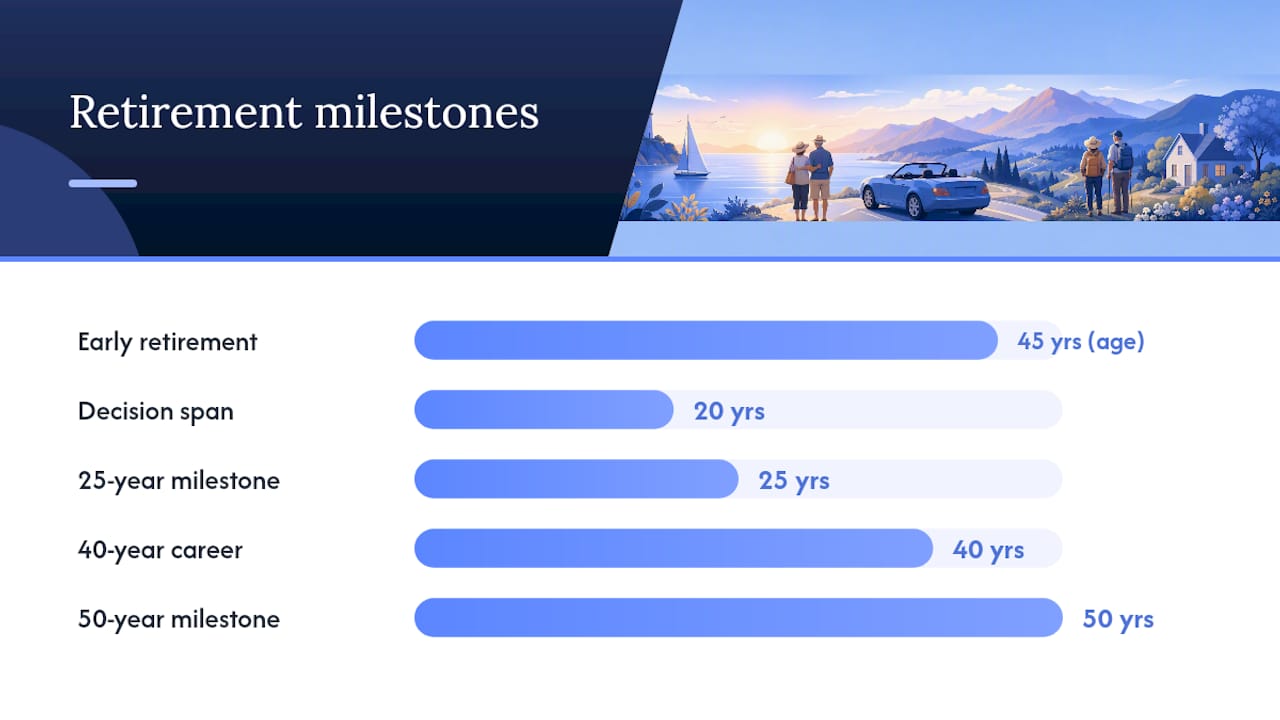
Milestone Retirements: Early Retirement and Long Service
Someone retiring at 45 after building a business or hitting an early financial goal deserves a message that celebrates the achievement itself, not just the milestone: “Retiring at your age isn’t luck, it’s twenty years of decisions most people never make. Enjoy every year you just bought back for yourself.”
A 40-year veteran of one company calls for a message that reckons with the sheer span of time: “You’ve worked here longer than some of us have been alive. That kind of loyalty and consistency built half of what this place is today. Thank you for four decades of showing up.”
For a milestone retirement tied to a specific number, like 25 or 50 years, naming the number directly adds weight: “Fifty years in one career is almost unheard of anymore. You didn’t just show up, you shaped this place. Enjoy the freedom you’ve more than earned.” Whether the retirement comes early or after decades, the message works best when it treats the number itself as worth mentioning, not just the fact of leaving.
Why a Thoughtful Card Still Matters
A card people actually keep isn’t the one with the cleverest line. It’s the one where somebody bothered to remember a specific Tuesday, a habit, a piece of advice that stuck. That’s the whole difference between a message that gets read once and one that gets pulled out of a drawer years later.
Group cards make this easier, not harder, when they’re built right. A wall where fifteen people each add one real memory becomes a fuller portrait than any single note could manage on its own.
Create a Group Retirement Card That Actually Gets Kept
A single handwritten card works fine for a small team, but once more than a handful of people want to sign on, a shared digital card solves a problem paper can’t: distance, timing, and remote coworkers who’d otherwise be left out entirely. Happy Wall lets anyone with the link add their own message, photo, or memory to one collective card, with no cap on how many people contribute, and it comes alive with music and animation when the retiree opens it.

That format beats a single note whenever more than two or three people want to be part of the send-off, since everyone’s contribution stays visible instead of getting crammed into a corner of a physical card. Once the wall closes, it can be kept as a digital keepsake or printed and mailed, so the retiree ends up with something they can actually hold onto. For companies that mark retirements regularly, the enterprise team option sets this up as a repeatable process rather than a one-off scramble. Start a wall for the next retirement on your calendar and see how quickly a team fills it with real memories instead of the same three phrases.
TL;DR:
- Specific details and memories make retirement messages more meaningful and memorable, increasing the likelihood that the recipient will cherish the card.
- Tailor the tone and content based on the relationship, using formal, casual, or humorous language appropriate to colleagues, friends, or family.
- Avoid generic phrases and clichés, instead focusing on concrete contributions, shared habits, or stories that reflect the retiree’s impact or personality.
- For group or virtual cards, collective contributions should add new memories or insights, rather than repeating similar lines, to create a tangible keepsake.
- Using simple templates with one personalized detail allows quick yet heartfelt messages that cover most circumstances.
Sources
- Indeed
- Retirement message guidance — Achievers
- Retirement wishes for a boss — Calm blog
- Retirement card message guidance — Mrs Fields (blog)
FAQ
What can you say instead of “happy retirement”?
Try phrases like “enjoy this well-earned chapter,” “here’s to time that’s finally yours,” or naming a specific wish, such as “enjoy every slow morning ahead.”
What are some good retirement wishes for cards?
Strong wishes combine congratulations with a specific detail about the person, such as “congratulations on a career that shaped so many of us, enjoy every trip you’ve been planning.”
What is a good retirement quote?
A simple, effective line is “the best rewards of a career are the ones you finally get time to enjoy,” though a personal detail about the retiree usually resonates more than a borrowed quote.
What are some good retirement wishes for a coworker?
Reference something specific, like a shared project or habit, then close with a forward-looking wish. A shared digital card, such as a collective message format, also lets a whole team contribute distinct wishes instead of one person carrying the message alone.