

Use a digital new hire welcome wall, an online shared card where colleagues add messages, photos, and wishes, to kickstart belonging for remote hires. It gathers unlimited contributors in one place, adds a layer of celebration through animation, and leaves a keepsake behind. A platform like this brings all of that together without asking you to stitch tools together yourself.
Key Takeaways
A digital welcome wall enhances remote onboarding by fostering belonging and personal connection before the first team interaction.
| Point | Details |
|---|---|
| Boosts sense of belonging | High-quality recognition increases employees’ belief they belong, reducing disengagement and job-hopping. |
| Prepares for onboarding milestones | Timing the wall around key dates ensures new hires feel welcomed with messages from colleagues. |
| Facilitates diverse contributions | Clear prompts and simple participation options encourage wide, authentic input from different team members. |
| Leverages easy setup tools | Platforms like Happy Milo simplify creation, contributions, and keepsake options, fitting into existing workflows. |
| Aligns with company culture | Customizable themes and messages reflect brand tone, making the wall a recognizable, ongoing tradition. |
Why a welcome wall matters for remote and distributed onboarding
Belonging is not a soft metric. Employees who receive high-quality recognition are up to 10 times as likely to strongly agree they belong at their organization, and those who lack belonging are up to 12 times more likely to be disengaged, and 5 times more likely to be job hunting, according to Gallup and Workhuman’s research on recognition and belonging. For a new hire who has never shaken a colleague’s hand, that first impression carries extra weight.
Remote newcomers face a specific risk researchers call membership ambiguity: the uncertainty of not knowing whether you truly belong to the team yet. Structured socialization rituals, from virtual coffee hours to buddy systems, help close that gap, and a welcome wall fits naturally alongside them.
It is not a replacement for manager-led onboarding or live water-cooler sessions. Think of it as the asynchronous layer underneath those efforts, the one place every colleague, not just the manager, gets to say something personal before the new hire’s first meeting even starts.

Setting up your welcome wall step by step
Before you open the invite link, settle a few decisions so the wall feels intentional rather than rushed.
- Pick an owner and a deadline. Someone on the team, often the manager or an HR partner, owns the wall and sets the day it closes.
- Choose visibility. Decide whether the link stays invite-only or opens to anyone with it, based on how public you want the celebration to feel.
- Write the title and starter message. Something like “Welcome to the team, Maya!” paired with a short line explaining what to add sets the tone for every contributor who follows.
- Add visuals and a reveal moment. Upload a team photo, pick a theme, and decide whether music or animation plays when the wall opens.
- Share the invite everywhere people work. Drop the link in Slack, Teams, or email, with a one-line prompt so nobody has to guess what to write.
- Set reminders. A nudge two or three days before the deadline catches the colleagues who meant to contribute and forgot.
- Open the wall at the reveal. Share it live in a welcome call or send it the morning of day one, then archive or print it once the moment has passed.
Pro Tip: Ask contributors for one concrete detail, like “share one tip for their first week,” instead of a generic “welcome,” so messages read as useful rather than interchangeable.
When to launch the wall and who to invite
Timing determines whether the wall lands as a warm surprise or an afterthought. New hires leaned more heavily on managers for onboarding support during the pandemic, and Microsoft’s Work Trend Index found that active manager involvement raised onboarding satisfaction. Tying the wall to specific milestones keeps that manager involvement visible rather than symbolic.
A workable rollout follows three checkpoints:
- Pre-start: send the invite to the team one to two weeks before the hire’s first day, so messages are ready before they log on.
- First day: reveal the wall during a welcome call or send the link that morning, with the manager highlighting a few favorite messages.
- Weeks one to three: reopen or extend the wall for colleagues who meet the new hire later, including cross-functional partners and, where it fits, a short note from an executive.
Folding the reveal into an already scheduled onboarding event, rather than sending it as a standalone email, keeps the moment from getting lost in a busy first week.
Message prompts that make writing easy
Most contributors stall not from lack of warmth but from not knowing what to say. Giving them a prompt by role removes that friction.
- Welcome, general: “So glad you’re joining us, welcome to the team!”
- Offer to help: “Ping me anytime, I’m happy to walk you through our tools.”
- Fun fact: “Here’s one thing about our team you won’t find in the handbook.”
- Team tip: “My best advice for your first week: ask questions early and often.”
- Tradition share: “We always celebrate wins on Fridays, you’ll fit right in.”
- Manager note: “Excited to see what you bring to this team, let’s grab time this week.”
- Executive note: “Welcome aboard, your work will matter here from day one.”
- Cross-functional partner: “Looking forward to working together, reach out whenever.”
Keep accessibility in mind: let contributors add a short voice note or photo instead of typing, and encourage plain, direct language over inside jokes that a brand-new colleague cannot yet decode.
Moderation, privacy, and keepsake choices
A wall works best with a light governance layer, not a heavy one.
- Set permissions upfront: decide whether the link is public or invite-only before you share it.
- Appoint one moderator: that person reviews flagged content within a short window, ideally before the reveal.
- Choose a keepsake format: keep the wall as a digital archive, download it as a PDF, or order a printed version through Happy Box, where a DIY keepsake runs €8.00 one-off and a premium assembled version runs €16.90 one-off.
- Decide on permanence: a standard wall expires on its own schedule, while removing that limit costs €2.99 one-off if you want it to stay accessible indefinitely.
A launch checklist you can run today
- Name an owner and a moderator, and set the wall’s visibility.
- Write the title, the starter message, and the contribution deadline.
- Draft the invite with two or three sample prompts attached.
- Schedule reminder messages for a few days before the deadline.
- Plan the reveal moment and decide whether it happens live or by link.
- Pick an archive or keepsake format before the wall closes.
Each step takes minutes, but skipping one, especially the reminder, is the most common reason participation falls short.
Measuring whether the welcome wall worked
Numbers tell part of the story. Track contributors, total messages, photos added, and how quickly the first message landed after you sent the invite. A wall that fills up within a day signals a team eager to participate; one that trickles in over a week may need a reminder or a better prompt next time.
Belonging is measurable too. Employees with high-quality recognition are up to 10 times more likely to strongly agree they belong, so a brief new-hire pulse check at day fourteen, asking about belonging and role clarity, gives you a direct read on impact.
- Note which prompts generated the longest, most specific messages.
- Flag any team or department that stayed quiet, and follow up personally next time.
- Ask the manager to mention a favorite wall message in the new hire’s first 1:1.
Weaving the wall into onboarding and company culture
A welcome wall lands harder when it is not an isolated gesture. Pair it with a short virtual coffee hour in the new hire’s first week, or fold it into an existing onboarding call so the reveal happens in front of the whole team rather than in a private message.
Some teams use the wall as the opening act for a longer onboarding arc: a welcome message on day one, a buddy system through week two, and a small team lunch or virtual social once the new hire has met most of their collaborators. Others connect it to recognition programs already in place, treating the wall as the newcomer’s first entry in a culture of regular, visible appreciation.

For distributed teams specifically, the wall can double as an introduction directory. Each message carries a name and a few lines of personality, which gives the new hire a head start on who does what long before an org chart would tell them. Encouraging cross-functional partners, not just the immediate team, to add a line widens that network from the first week rather than months in.
If your company already runs seasonal traditions, birthdays, work anniversaries, team wins, consider making a shared wall part of that same rhythm, so the new hire’s welcome feels like one entry in an ongoing culture rather than a one-off HR task.
Matching the wall’s look to your company’s brand
A welcome wall does not need to look generic. Most platforms let you set a theme, upload a team or office photo as the backdrop, and choose colors or an animation style that echoes your brand rather than a stock template.
Smaller touches matter too: the starter message can mirror your company’s actual tone, whether that is playful or formal, and the title can reference an internal nickname or team name rather than a generic “Welcome” header. Some teams add a short video clip or team photo gallery alongside written messages, giving the new hire a fuller sense of who they are joining.
For companies onboarding frequently, consistency across walls, same color palette, same structure, same closing animation, builds a recognizable ritual that new hires come to expect and current employees enjoy contributing to each time.
Technical fit with the tools your team already uses
A welcome wall should slot into your existing workflow, not add a new one. Most digital wall platforms generate a single shareable link that works inside Slack, Microsoft Teams, or a plain email, so there is no new login or app for contributors to install.
Because contributions happen through a browser, participation does not depend on a specific device or operating system, which matters for distributed teams spread across different company setups. Scheduling tools like Happy Agenda can also help you line up the wall’s reveal with a calendar event, so the countdown and the actual onboarding meeting stay in sync without manual tracking.
For teams planning an in-person follow-up alongside the digital reveal, local resources like these creative workshop ideas can round out the celebration once everyone is back in the same room.
Encouraging participation across remote and hybrid teams
The biggest barrier to a full wall is not reluctance, it is a vague invitation. Naming exactly what to write, and by when, consistently outperforms a general “feel free to add a note.”
Time zone spread is worth planning around directly: a 48 to 72-hour open window gives colleagues across regions a fair chance to see the invite before the deadline passes. A short reminder near the midpoint of that window, rather than only at the very end, catches people who missed the first message in a busy channel.
Making the ask visible also helps. A manager who contributes first, publicly, often signals to the rest of the team that this is worth five minutes of their time. Keeping the ask small, one line, one photo if they want, removes the excuse of not having enough time to write something longer.
Let Happy Wall handle the setup for you
We built Happy Wall so every step above takes minutes instead of hours. Any number of colleagues can add a message, photo, or short note with no cap on contributors, and the reveal brings music and animation to a moment that would otherwise be a quiet shared document.
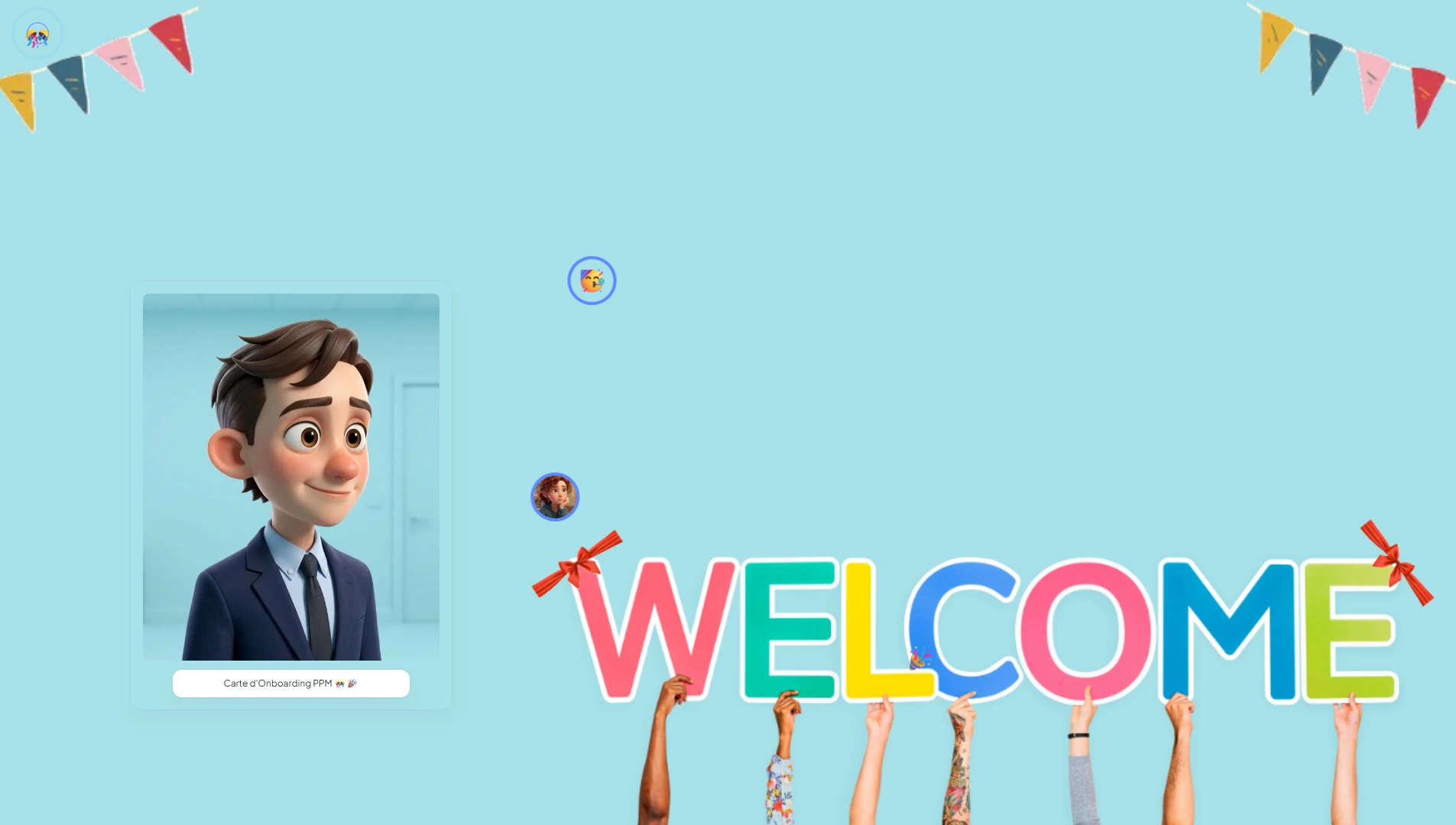
- Unlimited contributors join through one link, no app or account required.
- Keep the wall as a digital keepsake, or extend access permanently for a small one-off fee.
- Order a printed version through a partnered print service offering DIY and premium assembled options.
- Pair the wall with scheduling and countdown tools to time the reveal and build anticipation beforehand.
If your team onboards new hires often, the enterprise membership covers repeated walls without rebuilding the setup each time. Start your first wall on the Happy Wall product page and have it ready before your next new hire’s first day.
FAQ
What is a new hire welcome wall?
A new hire welcome wall is a shared digital card where colleagues add written messages, photos, and sometimes voice notes to welcome someone joining the team. It often includes animation at reveal and can be kept as a digital or printed keepsake afterward.
How long should a welcome wall stay open?
A one to two week window before the new hire’s start date gives colleagues enough time to contribute without the invite going stale. Extending it informally through the first three weeks lets cross-functional partners who meet the hire later add a note too.
Who should contribute to the wall?
The immediate team, the manager, and any cross-functional partners the new hire will work with closely should all be invited, with an optional short note from an executive. Research on remote onboarding points to the value of several introductions outside the immediate team to widen the new hire’s early network, as described in research on newcomer network dynamics.
Does a welcome wall replace manager check-ins?
No, a welcome wall works best as a complement to manager-led onboarding rather than a substitute for it. Regular virtual interactions with senior managers have been shown to improve newcomer outcomes in a Harvard Business School field experiment, so pairing the wall with scheduled 1:1s gets the best results.
Can we turn the wall into a physical keepsake?
Yes, once the wall closes you can order a printed version through Happy Box, with a DIY option at €8.00 one-off or a premium assembled version at €16.90 one-off. You can also remove the wall’s expiration for €2.99 one-off if you would rather keep it accessible online indefinitely.
Sources
- New Gallup Wellbeing and Workplace Study Finds Employee Recognition Can Help Mitigate $322 Billion Cost of Global Turnover and Lost Productivity
- Virtual water coolers: A field experiment on the role of virtual interactions on organizational newcomer performance
- Managers keep teams connected (Microsoft Work Trend Index)
- New employee network dynamics in remote onboarding