


Coworker Goodbye Messages That Sound Like You, With Group Card Workflow
Pick a message that matches your relationship, keep it short, and add one real detail. A safe template to start with: “[Name], working alongside you made every project better. Wishing you huge success in your next chapter, and let’s stay in touch!” Below you’ll find messages sorted by tone and relationship, plus quick rules for timing, length, and channel so whatever you send lands the way you mean it.
Table of Contents
- Coworker Goodbye Messages for Every Occasion, Sorted Fast
- Short and Sweet Coworker Farewell Messages You Can Send Right Now
- Heartfelt Farewell Wishes for a Mentor or Longtime Teammate
- Funny Coworker Farewell Messages (and When to Skip the Joke)
- Goodbye Messages by Relationship: Boss, Mentor, Remote Coworker, and More
- How to Write a Farewell Message That Actually Lands
- Collecting Messages With a Group Card or Digital Wall
- What a Professional or Formal Coworker Goodbye Message Sounds Like
- Phrases and Topics to Leave Out of a Goodbye Message
- Farewell Messages Across Cultures and Workplace Norms
- Why the Right Words Matter More Than People Expect
- Turn Scattered Well Wishes Into One Shared Send Off
- Sources
- FAQ
Coworker Goodbye Messages for Every Occasion, Sorted Fast
Not every send off calls for the same words. A quick Slack note for a teammate you chatted with daily needs a different register than a card for someone who mentored you for three years. Sorting by tone and occasion, rather than scrolling one giant list, gets you to the right coworker goodbye messages faster and cuts the chance you send something that feels off.
The categories below cover the situations you’ll actually run into: short notes for busy weeks, heartfelt lines for people who shaped your career, careful humor for the right crowd, and role-specific wording for bosses, mentors, and remote teammates you’ve never met in person.
Short and Sweet Coworker Farewell Messages You Can Send Right Now
When you’ve got thirty seconds and a card is already circulating, short wins. One or two sentences read as sincere, not rushed, and they fit a Slack thread, a group card, or a sticky note on a monitor just as well as a formal message would.
- “It won’t be the same without you here. Good luck out there, [Name]!”
- “You made this office better. Wishing you an amazing next step.”
- “Thanks for always making Mondays a little more bearable. Go crush it.”
- “So glad our paths crossed here. Keep in touch!”
- “Best of luck, [Name]. This team is losing a good one.”
- “You were the best desk neighbor a person could ask for. Miss you already.”
- “Congrats on the new adventure! You’ve earned it.”
- “Thanks for all the laughs and the coffee runs. Take care of yourself out there.”
- “Sad to see you go, thrilled for what’s next. Go get it.”
- “Working with you was a genuine highlight. See you around!”
- “You leave big shoes to fill. Enjoy the next chapter.”
- “This team won’t feel complete without you. Stay in touch!”
- “Every team needs someone like you. We got lucky for a while.”
- “Cheering for you from here on out. Don’t be a stranger.”
- “It’s been a privilege, [Name]. Wishing you nothing but good things.”
For a card, add the exact wording above as is, following the example of an engaging welcome for new team members to make the farewell feel personal and warm. For Slack or text, drop the greeting and lead with the sentiment. Short lists like these work well precisely because they read as sincere rather than filler.
Pro Tip: Swap in one specific detail, a project name, a shared inside joke, a habit you’ll miss, and the shortest message on this list will read as more personal than a long, generic one.
Heartfelt Farewell Wishes for a Mentor or Longtime Teammate
Longer messages earn their length when they name something specific. A mentor who taught you to run your first client meeting, a teammate who covered for you during a rough stretch, these relationships deserve more than a generic line, and naming the actual contribution is what makes the sincerity land.
- “I still think about the advice you gave me before my first big presentation. You made me a better [role], and I’ll carry that forward. Congratulations on this next step, you’ve earned every bit of it.”
- “Watching you handle [specific project] taught me more than any training ever could. This place is better because you were in it, and I’m a better professional because you took the time to show me how.”
- “You were the person I went to when everything felt like it was falling apart, and you never once made me feel small for asking. Wishing you a retirement (or next role) full of the peace you gave everyone else.”
- “Working under you shaped how I lead now. Thank you for the patience, the honesty, and the countless small lessons that added up to something big.”
- “You built something here that outlasts any org chart. Congratulations on closing this chapter, and thank you for letting me be part of it.”
- “I don’t think you know how many times your calm voice in a crisis kept the rest of us steady. Enjoy the slower mornings. You’ve more than earned them.”
- “From my first week here to now, you were the constant that made this job feel like a team instead of a job. Go enjoy everything you’ve been putting off.”
Retirement messages benefit from acknowledging years of service directly rather than dancing around it: naming a decade, a milestone project, or a specific memory carries more weight than “congrats on retiring.”
Funny Coworker Farewell Messages (and When to Skip the Joke)
Humor works when the relationship is close, the departure is voluntary, and nobody’s feelings are raw. It backfires fast in every other scenario.
- “Who’s going to steal my lunch from the office fridge now? Good luck, we’ll manage somehow.”
- “Congrats on escaping before the next reorg meeting. Smart move.”
- “You survived this place for years. That alone deserves a parade.”
- “Warning the next office: incoming chaos energy. Miss you already.”
- “You’re the only person who laughed at my terrible jokes. This is a real loss for me personally.”
Skip humor entirely if the departure involves a layoff, a forced exit, a health issue, or any visible tension between the coworker and leadership. A joke about “finally escaping” reads very differently when someone didn’t choose to leave. Cosmopolitan’s guidance on farewell tone puts it simply: safe humor never targets identity, performance, or the reason someone is leaving. When in doubt, rewrite the joke as warmth. “Who’s going to steal my lunch now” becomes “I’m going to miss our lunchroom chats more than I expected.”
Goodbye Messages by Relationship: Boss, Mentor, Remote Coworker, and More
The right wording changes depending on where the person sits relative to you.
- For a boss or mentor: “Thank you for believing in me even when I didn’t believe in myself. The lessons you taught me will follow me into every role after this one.”
- For a direct report: “Leading you was one of the best parts of this job. You’re ready for whatever comes next, and I mean that.”
- For a colleague you didn’t know well: “I always enjoyed our chats in passing. Wishing you the best in your next role.”
- For a remote or hybrid coworker: “We never shared an office, but you always showed up for the team. Let’s stay connected: here’s my personal email/LinkedIn.”
- For someone leaving a Discord or Twitch community you both worked in: “This community won’t be the same without your energy in chat. Thanks for showing up, week after week.”
Remote farewells carry one extra job: including a way to stay in touch, since there’s no hallway to exchange numbers in. A personal email or LinkedIn link solves that in one line, and larger example collections built for hybrid teams consistently flag this as the detail people forget.
How to Write a Farewell Message That Actually Lands
Good wording only works if the timing, length, and delivery match the moment.
- Send it before the last day, not on it. Sending a day or two early gives the person time to actually read and respond, instead of skimming it between packing boxes.
- Match length to channel. One line for Slack or text, one to three sentences for a card, and 100 to 150 words for a formal farewell email.
- Personalize with one real detail. Name the person, name one project or memory, and add a specific wish for their next step.
- Choose a sign off that fits the relationship. “Talk soon” for a close teammate, “Wishing you continued success” for a boss or client-facing contact, “Stay in touch” for anyone you’d genuinely like to hear from again.
Statistic Callout: Timing shapes how a message gets received almost as much as wording does. Career guidance from Indeed points out that a farewell sent shortly before someone’s final day, rather than on it, gives them room to actually respond instead of reading it while distracted by handoff tasks.
Pro Tip: If you’re stuck on wording, write the message as if you were saying it out loud to their face. The stiff, formal version almost always disappears once you imagine actually speaking it.
Collecting Messages With a Group Card or Digital Wall
One-off notes work fine for a single message. They fall apart the moment ten, twenty, or fifty people all want to say something to the same departing coworker, especially across a remote team spread over time zones.
A digital wall solves that coordination problem in four steps:
- Create the wall and set a closing date that lines up with the person’s last day or send-off event.
- Share the link in Slack, email, or a team channel so anyone can contribute.
- Let people add their own message, photo, or short video, no login required, no limit on contributors.
- Reveal it live, with music and animation, at the farewell gathering or over a video call.
Once the wall closes, it can stay as a digital keepsake the person reopens anytime, or become a printed card mailed straight to them. For a large in-office team, a printed keepsake often becomes the thing they keep on a desk for years afterward.
What a Professional or Formal Coworker Goodbye Message Sounds Like
Formal messages show up in scenarios where warmth still matters, but the relationship or setting calls for restraint, a farewell to a client-facing colleague, a note to someone several levels above you, or an email cc’d to a wider distribution list.
The structure that works: open with acknowledgment, add one specific note of appreciation, close with a professional wish.
“Dear [Name], I wanted to take a moment to acknowledge your contributions during your time with [team/company]. Your work on [specific project or responsibility] made a real difference, and your professionalism set a standard for the rest of us. Please accept my sincere wishes for continued success in your next role. It has been a genuine pleasure working alongside you.”
For a shorter formal note, appropriate for a card rather than an email: “[Name], thank you for your dedication and the example you set during your time here. Wishing you every success as you move forward.”
Formal doesn’t mean cold. It means fewer jokes, more specific professional acknowledgment, and a sign off like “Best regards” or “With sincere appreciation” instead of “Talk soon.”
Phrases and Topics to Leave Out of a Goodbye Message
Some wording feels harmless until you reread it from the other person’s side.
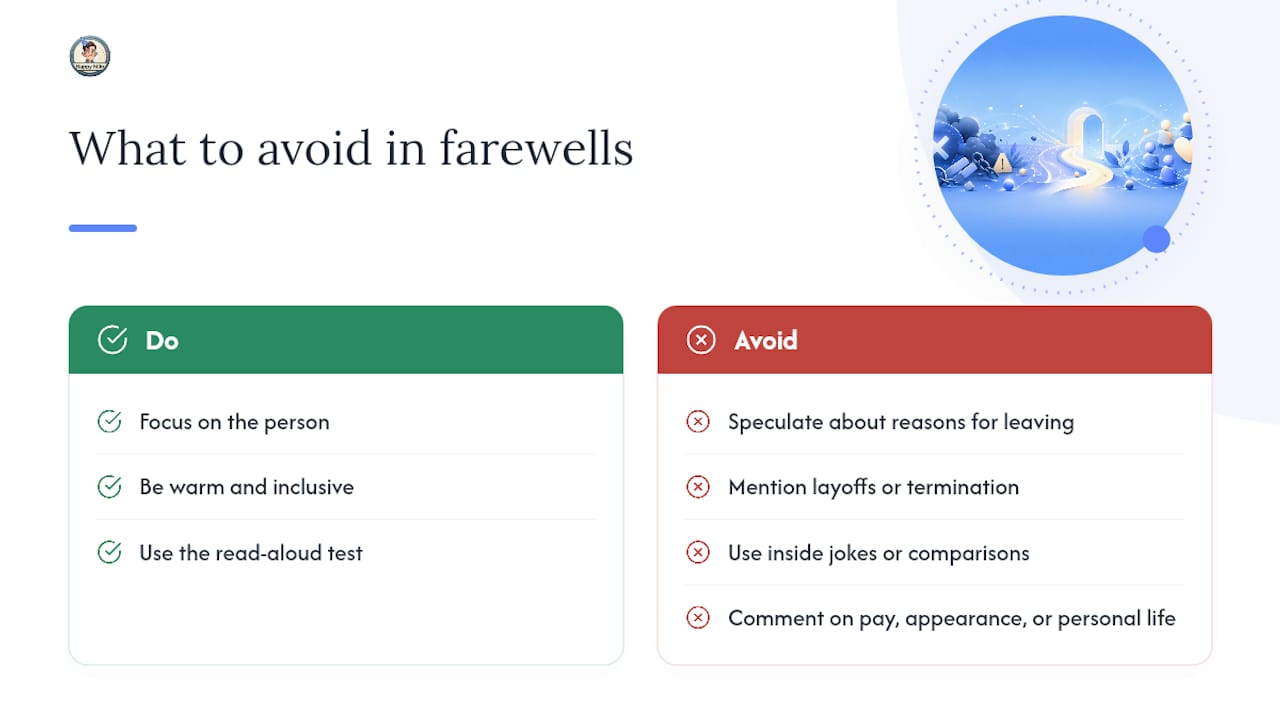
Avoid speculating about why someone is leaving, especially in writing that others might see. “Glad you’re finally getting out of here” implies the job was unbearable, which may not be true and definitely isn’t yours to declare. Skip references to layoffs, restructuring, or termination entirely unless the person has openly discussed it themselves, and even then, keep the message about them, not the circumstances.
Steer clear of inside jokes that exclude the wider group reading a shared card, comments about salary, comparisons to other coworkers (“at least you’re not stuck with [person] anymore”), and anything that reads as relief rather than warmth. Compliments about appearance or personal life also belong out of a workplace farewell, even when meant kindly. And resist the urge to use the message as a platform to vent about the company; it centers you instead of them.
If you’re unsure whether a line crosses a line, a simple test works: would you be comfortable if the departing coworker read it out loud to their new manager? If not, rewrite it.
Farewell Messages Across Cultures and Workplace Norms
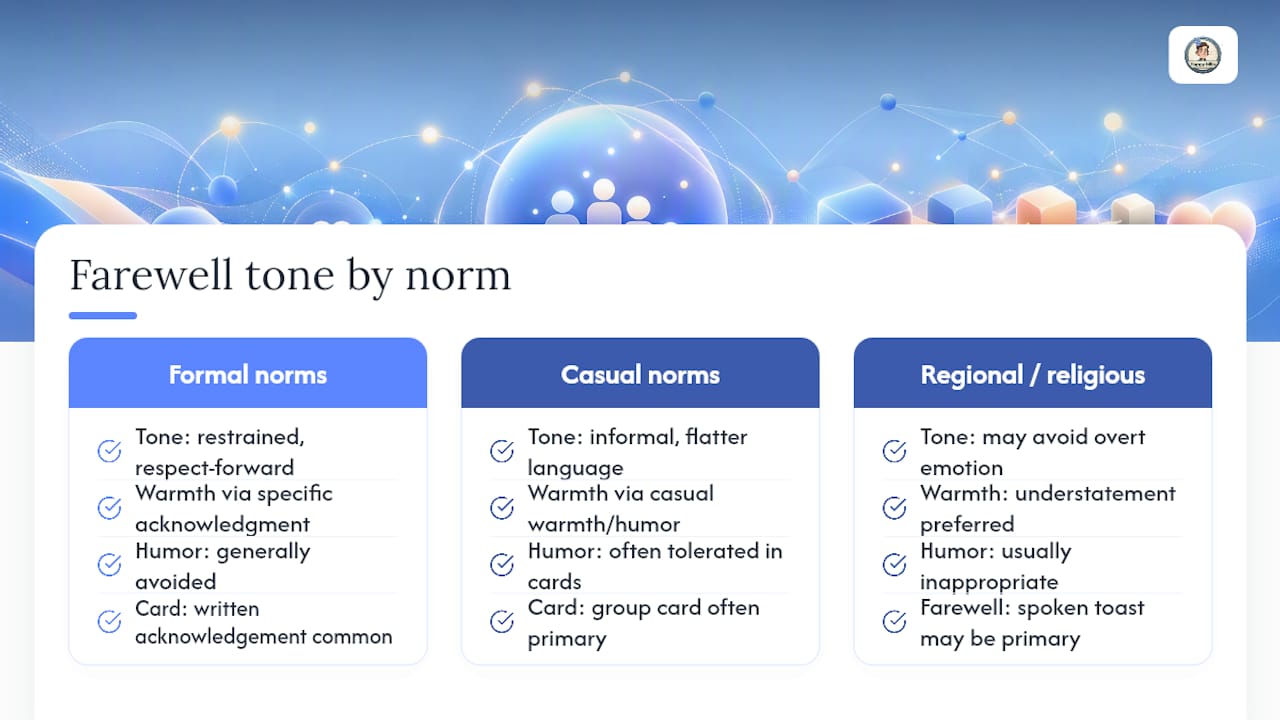
Farewell tone isn’t universal. Workplaces built around more formal hierarchies, common across much of East Asia and parts of Europe, tend to favor restrained, respect-forward language even for well-liked colleagues, with warmth expressed through specific acknowledgment rather than casual humor or emotional openness. Workplaces with flatter, more casual norms, common in many US and Australian offices, tolerate more humor and informality even in a group card.
Regional and religious context matters too. Some cultures avoid overt emotional displays in professional settings, preferring understatement over exclamation points and superlatives. Others expect a public toast or spoken tribute as the primary farewell, with the written card acting as a supplement rather than the main gesture.
When you’re unsure of the norms in a specific office or region, default to warmth without excess informality, skip humor unless you’ve seen colleagues use it in similar situations, and let the recipient’s own communication style guide your tone rather than a one-size-fits-all template. A message that feels perfectly warm in one office can feel oddly casual, or oddly stiff, in another.
Why the Right Words Matter More Than People Expect
I’ve read through hundreds of these messages while putting this piece together, and the pattern that stands out isn’t length or cleverness. It’s specificity. The messages that people screenshot and keep are the ones that name an actual moment: a project, a bad day someone helped with, a joke that only made sense to the two of them.
Generic warmth is fine. Specific warmth is memorable. If you take one thing from every template above, let it be this: swap the placeholder detail for a real one before you hit send, and choose the channel that matches how you actually talk to that person day to day.
Turn Scattered Well Wishes Into One Shared Send Off
Collecting messages from a whole team one Slack DM at a time is slow, and half the group forgets by the time the card actually goes around. Happy Wall fixes that by giving everyone one link to add their own message, photo, or video, no sign up required, and no cap on how many people join in.

For a remote team, that link works across time zones without anyone needing to be in the same room. For a large in-office send off, it means the quiet person who never speaks up in a group setting still gets to leave something personal. When the wall closes, it can stay as a digital keepsake the person reopens whenever they want, or turn into a printed card mailed to them as a keepsake. Companies that run farewells often, onboarding, milestones, repeat send-offs, can also set this up through Happy Milo’s enterprise option instead of starting from scratch each time. Pick a closing date, share the link with the team, and let everyone’s words come together in one place before the last day arrives.
Sources
- 60 Farewell Messages to a Colleague Leaving
- Farewell Message to Colleague: Thoughtful Examples 2026
- 46 Ways To Say Farewell to Your Coworkers or Manager | Indeed
- Farewell messages for colleagues: The best messages for your card
FAQ
What is a good message to say goodbye to a coworker?
A good message names something specific, a shared project, a habit, a memory, then closes with a genuine wish for what’s next, rather than relying on generic phrases like “good luck out there.”
What is a short and sweet farewell message?
A short, sweet message runs one to two sentences, works well for cards or Slack, and typically pairs a warm observation with a simple wish, like “This team won’t be the same without you. Wishing you huge success ahead.”
How do I say goodbye to my work colleagues?
Choose your channel based on the group’s size and location: a card or spoken toast for an in-office team, or a shared digital wall like Happy Wall when the team is remote or too large to pass a single card around.
How do you say goodbye professionally?
A professional farewell opens with acknowledgment, names one specific contribution, and closes with a formal wish for continued success, sent shortly before the person’s last day so they have time to actually read it.