


Shared joyful experiences are the primary mechanism through which human beings form lasting social bonds. Science now confirms that why happy moments bring people together goes far deeper than good feelings. When people laugh together, eat together, or celebrate a milestone side by side, their bodies and minds synchronize in ways that build empathy, trust, and closeness. These effects show up in friendships, romantic partnerships, families, and entire communities. Understanding the specific mechanisms at work gives you a practical map for creating more connection in your own life.
Why happy moments bring people together, according to science
The bonding power of shared joy operates through two distinct channels: physiological synchrony and mutual meaning-making. Physiological synchrony is the technical term researchers use to describe the automatic coordination of body rhythms between people who share an experience. When you laugh at the same joke as a friend, your breathing patterns, heart rates, and even neural activity begin to mirror each other. That mirroring is not a metaphor. It is a measurable biological event that increases feelings of empathy and familiarity.
A 2026 experiment published in Scientific Reports found that synchronized breathing with joyful expressions raises empathy scores beyond what happens when people simply view a happy face without that synchrony. The researchers used radar technology to detect breathing coordination in real time, making this one of the most precise measurements of embodied connection ever recorded. The implication is direct: shared joy does not just feel good. It physically aligns you with another person.
Laughter, group singing, and communal chanting are the most common everyday triggers of this synchrony. Sports fans chanting in a stadium, a congregation singing hymns, or a group of friends erupting in laughter at a dinner table are all producing the same biological effect. Physiological synchrony fosters affiliation, trust, and cooperation, which explains why these communal activities have appeared in every human culture throughout recorded history.
Pro Tip: The next time you want to deepen a connection with someone, choose an activity that naturally synchronizes your bodies. Singing, dancing, or even a brisk walk together produces more bonding than a conversation over coffee.
How joint savoring deepens relationships beyond the moment
Joint savoring is the practice of mutually focusing attention on a pleasurable experience as it unfolds, and it is categorically different from enjoying something on your own. When you savor a sunset alone, you feel good. When you savor it with a partner or friend, both of you actively amplify the experience for each other through comments, gestures, and shared attention. That interactive loop is what makes joint savoring a relationship maintenance strategy rather than just a mood booster.
Research on 589 couple dyads using regression models shows that joint savoring in romantic relationships correlates positively with relationship well-being even after controlling for general savoring habits and demographics. This means the benefit is not simply about being a happy person who happens to be in a relationship. The mutual, interactive quality of the savoring is what drives the effect. Couples who practice it report stronger closeness, better communication, and greater satisfaction.
The University of Illinois reports that savoring moments with a partner mutually strengthens relationship closeness and quality in ways that individual savoring cannot replicate. This finding matters because most happiness advice focuses on personal practices like gratitude journaling or mindfulness. Joint savoring shifts the focus outward, toward the relationship itself as the unit of well-being.
The good news is that joint savoring applies well beyond romantic partnerships. Here is how it shows up across different relationship types:
- Friendships: Reliving a funny shared memory together, or pausing during a great meal to say "this is really good," activates the same mutual amplification effect.
- Family bonds: Parents who narrate joyful moments to young children ("Look at that, isn't that amazing?") are practicing joint savoring and building secure attachment at the same time.
- Work teams: Celebrating a project win together, rather than moving immediately to the next task, gives teams a savoring moment that reinforces cohesion and morale.
- Online communities: Sharing a video or photo with a comment that invites others to appreciate it together extends joint savoring into digital spaces, provided the sharing feels authentic rather than performative.
The stress-buffering effect of joint savoring is also worth noting. Couples who regularly savor positive moments together show greater resilience during difficult periods, because the emotional reserves built through shared joy provide a buffer against conflict and strain.
Why everyday shared rituals matter more than big celebrations
Most people assume that major celebrations, weddings, milestone birthdays, graduation parties, are the primary drivers of social connection. The data tells a different story. Routine shared moments, particularly shared meals, may be more important for consistent social health than any single grand event.
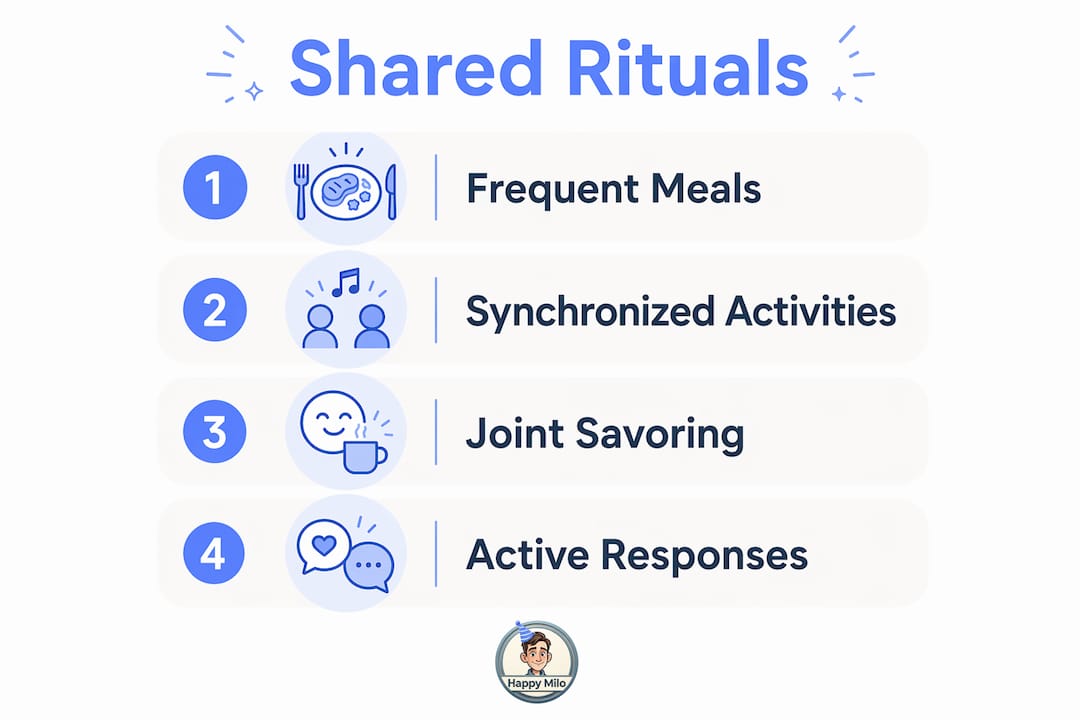
A large-scale study using Gallup World Poll data from 142 countries found that sharing meals frequently correlates with higher happiness and lower stress, pain, and sadness both globally and in the United States specifically. The effect held across cultures, income levels, and age groups. This means meal sharing functions as a nearly universal social resource, not a luxury reserved for special occasions.
The table below summarizes the wellbeing impact of shared meals compared to other common social indicators:
| Factor | Wellbeing impact |
|---|---|
| Frequent shared meals | Higher happiness, lower stress and pain globally |
| Solo meals (increasing trend) | Associated with loneliness and lower life satisfaction |
| Meaningful shared activities | More positive affect, less negative affect during the activity |
| Socioeconomic status alone | Weaker predictor of happiness than social context of activities |
The trend toward solo meals is accelerating in many high-income countries, and the social cost is measurable. When people eat alone regularly, they lose one of the most accessible daily rituals for maintaining social bonds. The fix does not require a dinner party. A shared lunch with a colleague or a family breakfast three times a week produces the same connective effect.
Analysis of American Time Use Survey data confirms that health behaviors done with others in a meaningful context produce more positive affect and less negative affect than the same behaviors done alone. The social and meaningful context is the active ingredient, not the activity itself. A walk with a friend beats a solo run on every wellbeing metric that matters for connection.
Pro Tip: Schedule one shared meal per day as a non-negotiable, even if it is just a 20-minute lunch with a coworker or a family dinner without phones. Consistency matters more than occasion.
The Happy-milo agenda is a practical tool for keeping shared moments on the calendar. It lets you schedule recurring celebrations and reminders so that the small joyful rituals do not get crowded out by busy weeks.
How enthusiastic responses amplify shared joy and strengthen bonds
Sharing good news with someone is only half the equation. What happens next, specifically how the other person responds, determines whether the moment becomes a genuine bonding experience or a missed opportunity. Psychologists call the most effective response style active-constructive responding.
Active-constructive responding means reacting to someone's positive news with enthusiasm, elaboration, and genuine engagement. When a friend tells you they got a promotion, an active-constructive response sounds like: "That's incredible! Tell me everything. What does this mean for you?" The contrast is a passive response ("Oh, that's nice") or a deflecting one ("Just wait until the extra workload kicks in"). The difference in relational outcome is significant.
A 2026 report from Scott Free Clinic highlights that active-constructive responding to shared happiness is the single most beneficial reaction style for increasing intimacy and relationship satisfaction. The research shows that people who receive enthusiastic, elaborative responses to their good news feel more understood, more valued, and more connected to the person who responded. Over time, this pattern builds the kind of trust that sustains long-term relationships.
Here is a practical framework for applying active-constructive responding across different contexts:
- Pause before responding. Give yourself two seconds to register what the other person just shared before you react. This prevents reflexive, distracted responses.
- Ask an open question. "Tell me more" or "How did that happen?" signals genuine interest and invites the other person to relive the positive experience, extending the joy.
- Match their energy. If someone is excited, meet that excitement. Emotional mirroring is a form of physiological synchrony and deepens the sense of being truly seen.
- Revisit it later. Bringing up someone's good news in a future conversation ("How is that new project going?") shows you were paying attention and that their joy mattered to you.
- Apply it in team settings. Managers who celebrate team wins with genuine enthusiasm, rather than a quick "good job" before moving on, build stronger team cultures and higher retention.
Online sharing adds a layer of complexity. A 2025 systematic review found that authentic online self-disclosure increases social connection, but strategic impression management, posting primarily to look good rather than to genuinely share, can reduce liking despite generating engagement. The lesson is that the same rules apply online as offline. Authenticity and social attunement are what convert a shared moment into a real bond, whether the interaction happens in person or through a screen.
Celebrate every moment with Happy-milo
Shared joy builds real connection, and Happy-milo exists to make sure distance never gets in the way of that.
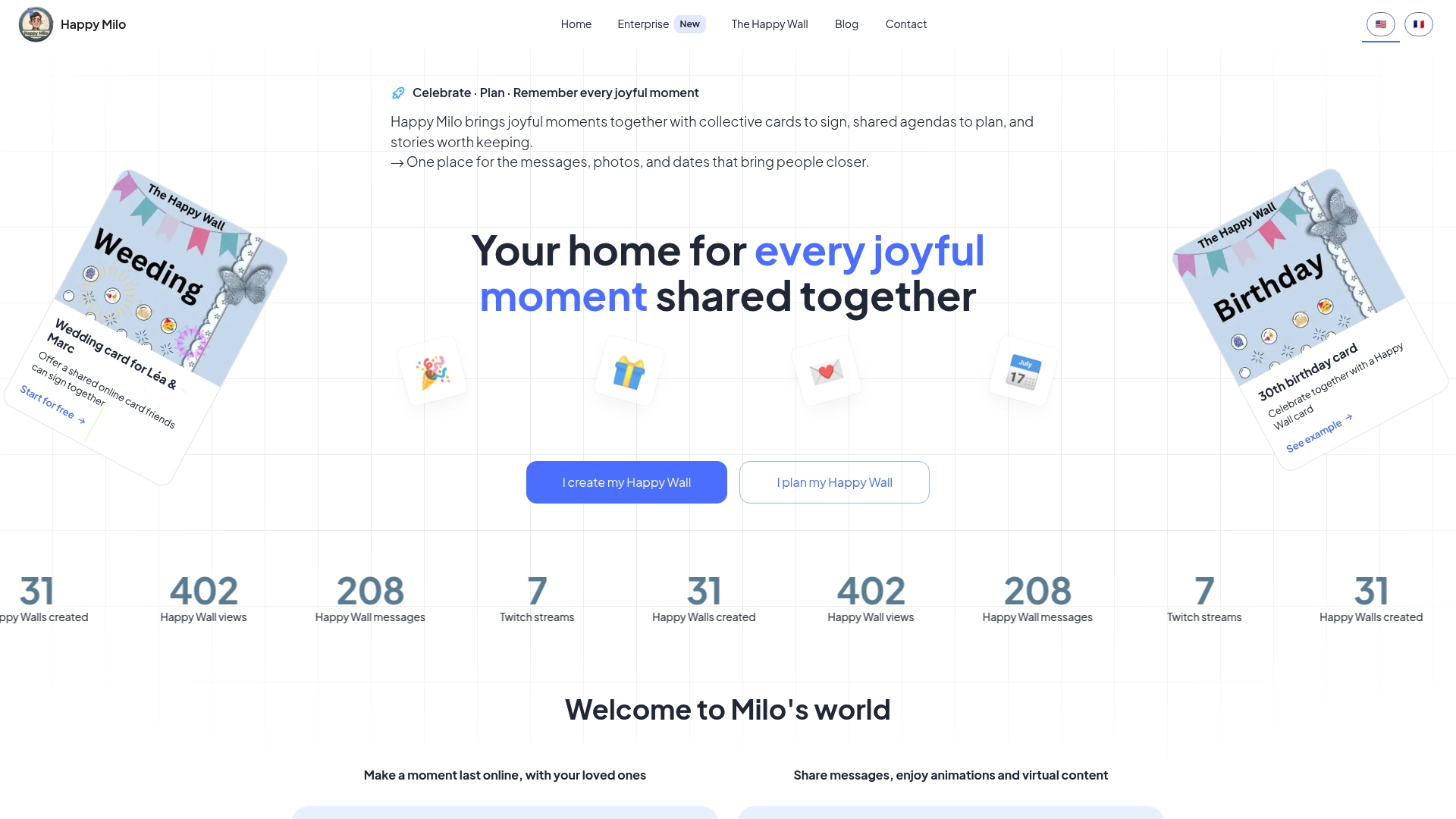
Happy-milo's Happy Wall is a digital group card where friends, family, and colleagues can leave unlimited messages, photos, and memories for any occasion. Birthdays, farewells, weddings, team milestones: every celebration deserves more than a single card. With virtual fireworks and animations, the Happy Wall turns a simple message into a full celebration. For teams, Happy-milo's enterprise card solutions make onboarding, farewells, and milestones feel genuinely warm, no matter where your people are located. Start a Happy Wall today and let the joy multiply.
Key takeaways
Shared joyful experiences build social bonds through physiological synchrony, joint savoring, and enthusiastic responding, making happiness the most reliable social glue available to every person.
| Point | Details |
|---|---|
| Physiological synchrony | Synchronized breathing and movement during shared joy increase empathy and familiarity measurably. |
| Joint savoring | Mutually focusing on pleasurable moments strengthens relationship quality beyond what individual happiness achieves. |
| Everyday shared rituals | Frequent shared meals correlate with higher happiness globally, outperforming socioeconomic factors as a wellbeing predictor. |
| Active-constructive responding | Enthusiastic, elaborative reactions to good news increase intimacy and satisfaction in all relationship types. |
| Authentic online sharing | Digital sharing strengthens connection when it is genuine and socially attuned, not performative. |
FAQ
Why do happy moments bring people closer together?
Happy moments trigger physiological synchrony, aligning breathing and body rhythms between people, which increases empathy and a sense of familiarity. This embodied coordination, combined with mutual attention and positive emotion, creates the conditions for genuine social bonding.
What is joint savoring and why does it matter for relationships?
Joint savoring is the practice of mutually focusing on a pleasurable experience with another person, and research on 589 romantic couples shows it improves relationship well-being beyond what individual savoring achieves. It works because the interactive loop of shared attention amplifies positive emotion for both people simultaneously.
How do shared meals contribute to happiness and connection?
Sharing meals frequently correlates with higher happiness and lower stress across 142 countries, according to Gallup World Poll data. The social context of eating together, not the food itself, is the active ingredient driving this wellbeing effect.
What is active-constructive responding?
Active-constructive responding is an enthusiastic, elaborative reaction to someone else's good news, and it is the response style most strongly linked to increased intimacy and relationship satisfaction. Responding with genuine curiosity and energy, rather than a brief acknowledgment, signals that the other person's joy genuinely matters to you.
Can online sharing of happy moments build real connection?
Yes, provided the sharing is authentic and socially attuned. A 2025 systematic review found that genuine online self-disclosure increases social connectedness, while sharing designed primarily to manage impressions reduces liking even when it generates engagement.