
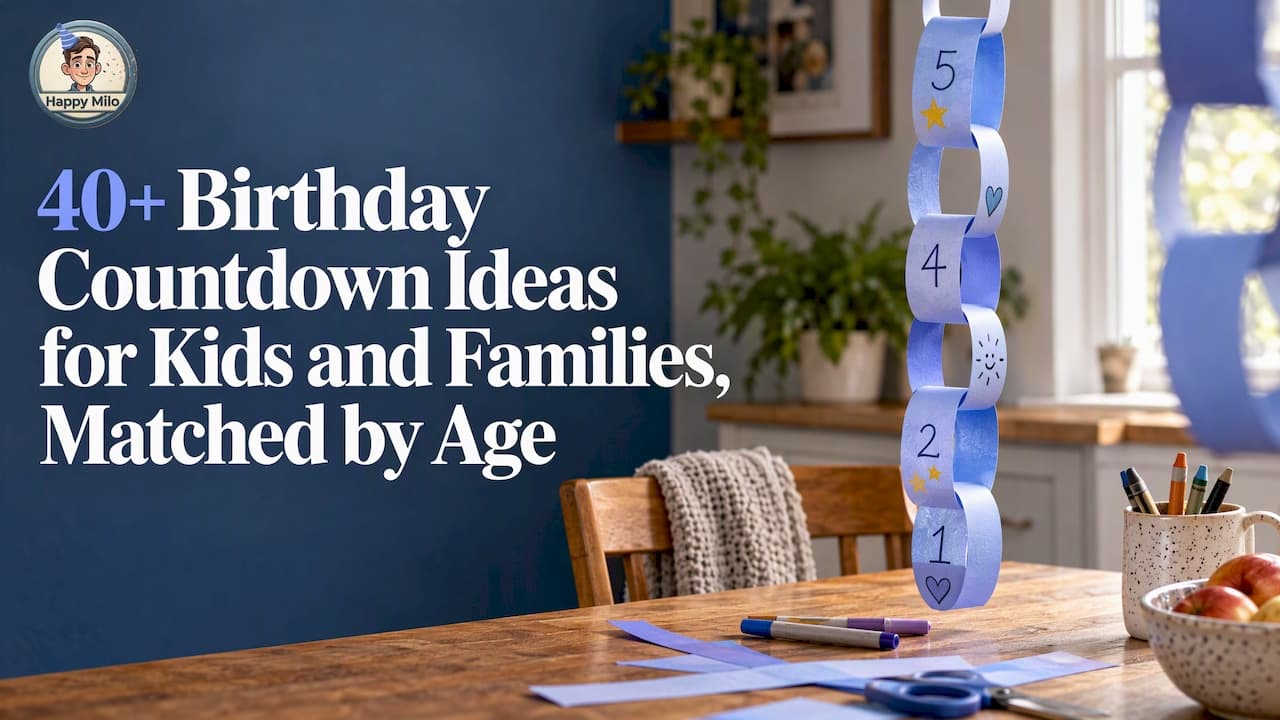

For ages 3 to 7, a tactile countdown like a paper chain or sticker calendar works best because little hands can touch and tear something real. For school-age kids, numbered envelopes with small daily prompts hold attention without overpromising. For teens and remote friends, an Instagram countdown sticker or a short digital timer fits how they already celebrate. Below, we gathered more than 40 ideas, DIY steps, and quick setups so you can pick one tonight.
Key Takeaways
Different age groups require tailored birthday countdowns, with physical tactile displays for younger children and digital timers for teens and remote celebrations.
| Point | Details |
|---|---|
| Young children need short countdowns | Toddlers and preschoolers benefit from countdowns lasting only a few days to maintain excitement. |
| Physical vs digital countdowns | Tactile formats like paper chains suit younger kids, while teens prefer digital timers and social media stories. |
| Match countdown style to child’s interests | Choose an idea that aligns with the child’s age and preferences, like stickers for toddlers or photos for older kids. |
| Keep the countdown simple and steady | Tie daily check-ins to routine events to create a predictable, calming ritual for children. |
| Happy Milo enhances shared celebration | We recommend using Happy Milo’s digital walls and printing options to preserve memories and include distant loved ones. |
1. Creative Birthday Countdown Ideas Grouped by Style
A good countdown matches the format to the kid, the timeline, and how much crafting energy you have left in the week. Here are more than 40 ideas sorted by style, each with a quick note on how it works and who it suits best.
- Paper chain: tear one link each morning; great for ages 3 to 10 and easy to personalize with drawings.
- Countdown calendar: a printed grid where kids check off days; works for school-age kids who like structure.
- Cake-flap calendar: a cake-shaped poster with numbered flaps hiding small notes; fun craft project for a weekend afternoon.
- Numbered envelopes: one envelope per day with a tiny activity or question inside; flexible for any age.
- Sticker calendar: add one sticker per day to a wall chart; ideal for toddlers who love repetition.
- Balloon pop countdown: pop one balloon daily to reveal a note inside, as described in this DIY birthday countdown guide.
- Mini advent-style boxes: small numbered boxes with a treat or token, reused from holiday advent calendars.
- Privilege countdown: each day unlocks a small privilege, like choosing dinner or skipping a chore.
- Jar of folded notes: pull one slip from a jar each morning; low-prep and reusable next year.
- Countdown jigsaw: assemble one puzzle piece daily, revealing a full picture on the big day.
- Window chalk countdown: write the number on a window with washable chalk markers, updated nightly.
- String and clothespin countdown: clip numbered cards to a string; swap or add notes easily.
- Countdown scavenger hunt: hide one clue a day leading toward a small surprise.
- Milestone reveal envelopes: for milestone birthdays, use envelopes that build toward a bigger reveal, like a trip or party theme.
- Teen experience countdown: count down to a planned outing or event with a short digital timer instead of physical props.
- Daily photo countdown: post one photo a day from past birthdays, building a visual memory lane.
- Countdown playlist: add one new song to a shared playlist daily, building toward a birthday soundtrack.
- Recipe countdown: try one new snack or treat each day leading up to the party.
Several of these pair naturally with daily prompts like skipping a chore, choosing a dessert, or picking a game, which keeps costs low and anticipation steady, as outlined in DIY countdown research.
2. How Long Should a Birthday Countdown Run by Age?
The right countdown length depends on how well your child grasps time, not just their excitement level. Shorter windows keep younger kids from losing interest or feeling overwhelmed, while visuals like a chain or calendar make abstract days feel concrete.
- Toddlers (ages 1 to 2): 3 to 5 days, since longer periods mean little and can feel confusing.
- Preschoolers (ages 3 to 5): about a week, short enough to stay exciting from start to finish.
- School-age kids (ages 6 to 10): 1 to 2 weeks, long enough for a paper chain or envelope set to feel substantial.
- Tweens and teens: 2 to 4 weeks, often tracked digitally rather than with a physical display.
Countdowns for young children work best within short, limited time windows to stay effective, and younger toddlers need even shorter spans, according to birthday countdown guidance for kids.
Nearly 7 in 10 kids begin anticipating their birthday at least a month ahead, with anticipation windows lengthening as children get older, based on a survey of 5,013 parents. That means your countdown display can start closer to the date, since the anticipation often starts well before you build anything.
3. Build It Yourself: Paper Chains, Envelopes, Balloons, and Mini Boxes
Each of these formats takes under an hour to assemble and reuses supplies you likely already have at home, or you can simplify your setup with a classic birthday box ready to go.
Paper chain (low effort, low cost)
- Cut construction paper into strips, one per day of your countdown.
- Write or draw the day’s number on each strip.
- Loop and glue or tape strips into a connected chain.
- Hang it somewhere visible and tear one link each morning.
Numbered envelopes (medium effort, low cost)
- Gather small envelopes, one per countdown day.
- Number each envelope on the front.
- Write a short prompt or activity on a slip of paper for each one, such as choose a dessert or pick a game, drawn from common countdown activities in DIY countdown ideas.
- Seal and arrange them in order on a string or in a basket.
Balloon pop countdown (medium effort, low cost)
- Write a number on each balloon before inflating.
- Insert a small folded note or lightweight treat before blowing it up, a method confirmed in this balloon countdown project.
- Tie balloons together or display in a cluster.
- Pop one balloon per day in countdown order.
Mini advent-style boxes (medium effort, medium cost)
- Reuse small boxes or matchboxes, one per day.
- Number the lids clearly.
- Fill each with a tiny token, sticker, or note.
- Arrange on a shelf or tray for daily opening.
- Printable chains and templates are widely available free online, with step-by-step cutting instructions you can scale to any countdown length.
- Print a few extra blank links or envelopes so you can personalize later without reprinting the whole set.
4. Setting Up a Digital or Social Countdown
A digital countdown fits teens, remote friends, or anyone celebrating a streamer’s channel anniversary, while tactile formats still win for younger kids who need something to touch.
- Open Instagram Stories, tap the sticker icon, choose “Countdown,” name the event, and set the end date and time.
- Viewers can tap the sticker to set their own reminder, which helps when family is spread across time zones.
- Instagram countdowns max out at 12 months and run as short as 1 minute, and names longer than 20 characters may truncate visually, per this Instagram sticker guide.
- For a hybrid approach, run a digital countdown for weeks ahead, then switch to a physical paper chain or sticker calendar for the final 5 to 7 days.
5. Quick Countdowns You Can Set Up in Under 30 Minutes
When the birthday is close and nothing is ready yet, these options come together fast with items already in the house.
- Grab a jar and some scrap paper, write one activity per slip, and pull one daily.
- Use sticky notes on a mirror, numbered backward from the big day.
- Draw a simple grid on printer paper and check off boxes each morning.
- Tape a string across a wall and clip index cards with numbers written in marker.
- Repurpose an egg carton as a mini advent box, one treat per cup.
- Set a phone countdown timer and screenshot it daily as a quick visual reminder.
- Compress any idea on this list into 3 to 7 days by numbering backward from the party date instead of starting from scratch.
Pro Tip: Use egg cartons, cereal boxes, or sticky notes as instant countdown materials when you have no time to shop or print anything.
6. Keeping the Countdown Calm, Not Chaotic
A countdown works best as a steady ritual, not a daily escalation. Tie the daily check-in to something that already happens, like breakfast or bedtime, so it becomes a predictable moment rather than a source of pressure, a strategy echoed in guidance on building countdown routines.
- Keep daily rewards small and steady, think stickers or a chosen song, not escalating toward bigger gifts each day.
- When a child asks “how long until my birthday,” try asking “what can you try while you wait,” a tactic shown to help kids manage anticipation, according to guidance on teaching children to wait.
- If a countdown involves balloons or small boxes with treats inside, supervise young children directly, since small items and balloon fragments carry choking risks.
Nearly 7 in 10 kids start anticipating their birthday a month or more ahead, which means a calm, well-paced countdown often matters more than an elaborate one, per parent survey data.
7. Adding Shared Digital Messages to Your Countdown
A physical countdown builds anticipation at home, but it does not capture what grandparents, cousins, or far-off friends want to say. That is where a shared digital wall fits naturally alongside the chain or calendar on your fridge.
With Happy Wall, anyone with the link can add a message, photo, or wish, and there is no cap on how many people join in. You might send the link out on the same day you hang your paper chain, so messages trickle in over the same days your child is tearing links or opening envelopes. When the birthday arrives, the wall comes alive with music, confetti, and animation, turning every contributed message into one shared moment.
This pairs especially well with milestone birthdays, where you want more than a single card. It also works for a child’s class, a scattered extended family, or a grandparent who cannot travel but still wants to be part of the countdown. The wall becomes a second, parallel countdown of its own: one you watch fill up with names and notes while the physical display counts down the days.
8. Syncing Daily Countdown Activities With Group Contributions
One way to make a countdown feel bigger than one household is to connect its daily rhythm to an ongoing group wall. If your countdown includes a daily prompt, like choosing a dessert or picking a song, you can share that day’s pick with the group contributing to a shared wall, turning a private ritual into something others can respond to.
For example, if day 5 of your countdown asks your child to pick a favorite memory, post that memory to the group wall and invite relatives to add their own version of the same memory. If day 2 involves choosing a photo, let family members react or add their own photos to the same thread. This turns a solo countdown into a running conversation that peaks on the birthday itself, when the wall reveals its animation and every contributed message appears at once.
It also solves a common problem with long-distance countdowns: tactile formats like paper chains do not travel well, but a shared wall link does. Family in another city or country can watch the days tick by through their own notifications rather than a photo you send separately each morning.

9. Coordinating Countdowns Across Families, Offices, and Online Groups
The right coordination approach depends heavily on who is counting down together. A family countdown usually centers on one child and a small circle of relatives, so a single shared link works fine, sent once and revisited daily. An office countdown for a colleague’s birthday needs a bit more structure, since contributors are busier and the deadline is firmer: sending the link early with a clear closing date raises the odds that everyone adds something before the day arrives.
Online communities, including Discord servers or a streamer’s audience, benefit from framing the countdown as part of the event itself. Pinning the link in a channel or mentioning it during a stream gives dozens or hundreds of viewers a reason to add a quick note between other activity, something explored further in ideas for celebrating a streamer’s birthday live.
Across all three group types, the common thread is giving people a specific window to act. A wall left open indefinitely gets fewer contributions than one tied to a visible countdown and a known closing date, which is part of why pairing a digital message wall with an actual countdown display, physical or digital, tends to pull in more participation than either alone.

10. Preserving Countdown Memories Once the Birthday Passes
A paper chain gets recycled and a balloon gets swept up, but the messages collected during the countdown do not have to disappear with them. Once a wall closes, it can be kept as a digital keepsake or turned into a printed card mailed to the person it was made for, through Happy Box.
If you want the wall to stay accessible indefinitely rather than closing on schedule, there is an option for no expiration on your Happy Wall at €2.99 one-off, listed on the pricing page. For a physical keepsake, Happy Box DIY starts at €8.00 one-off, while Happy Box Premium runs €16.90 one-off for a fully assembled printed card, both detailed on the same pricing page.
This matters most for milestone birthdays, where the countdown itself becomes part of the story worth remembering, not just the party day. Linking the countdown period to a saved wall means the anticipation, not just the celebration, gets preserved alongside every message that came in during those final days.
11. Keeping Everyone on Schedule With Event Planning Tools
A countdown only works if the people meant to join in actually remember to do it. Reminders matter as much as the countdown format itself, especially when a group spans different schedules or time zones.
Happy Agenda helps round out the countdown experience by giving planners a way to track key dates and keep contributors from forgetting to open or add to a wall in time. Pairing a countdown display with a planning reminder means the birthday child’s chain or calendar is not the only thing keeping track of the date, someone is also making sure the digital side stays on schedule.
For readers juggling a countdown alongside broader party logistics, a milestone birthday planning checklist can help keep the countdown connected to the rest of the celebration rather than existing on its own timeline.
12. Try a Shared Digital Countdown and Celebration Board
If a physical countdown feels like one more craft project on an already full week, a shared digital setup covers the same ground with less assembly. We built Happy Dates and Happy Wall so groups can count down together while collecting messages in one place, no cutting, taping, or printing required.

- Unlimited contributors can add a message, photo, or wish with no cap on group size.
- The wall comes alive with music, confetti, and animation when the countdown ends.
- Once closed, the wall becomes a digital keepsake or a printed card through Happy Box.
- Works the same for a family group, an office team, or an online community.
Start your free wall today at Happy Wall and let the countdown build itself around everyone’s words.
FAQ
How do I make a countdown for my birthday?
Pick a format that matches your timeline and energy, such as a paper chain, numbered envelopes, or a sticker calendar, then number the days backward from your birthday. For a quick setup, a jar of folded activity slips or a sticky note grid works just as well and takes under 30 minutes to assemble.
How do I make a birthday special last minute?
Use household items like sticky notes, an egg carton, or a phone timer screenshot to create a quick countdown with no shopping required. Pair it with a small daily ritual, like choosing dessert or picking a song, to make the final days feel intentional even without advance planning.
How do I post a birthday countdown on Instagram?
Open Instagram Stories, tap the sticker icon, select “Countdown,” name the event, and set the end date and time so viewers can tap to set their own reminder. Keep in mind that countdowns run as short as 1 minute and max out at 12 months, and names longer than 20 characters may truncate visually, according to this Instagram sticker guide.
How many days are left for my birthday countdown?
The right number of days depends on age: toddlers do best with 3 to 5 days, preschoolers with 5 to 7, school-age kids with 1 to 2 weeks, and tweens or teens with up to 2 to 4 weeks, often tracked digitally. Starting too early for a young child risks losing their interest before the big day arrives, per guidance on countdown timing for kids.
Sources
- Birthday Countdown Ideas for Kids - Build Anticipation Right
- Instagram questions & sticker usage guide
- DIY Birthday Countdown - Crafting Cheerfully
- When kids start anticipating their birthday | Birthday research